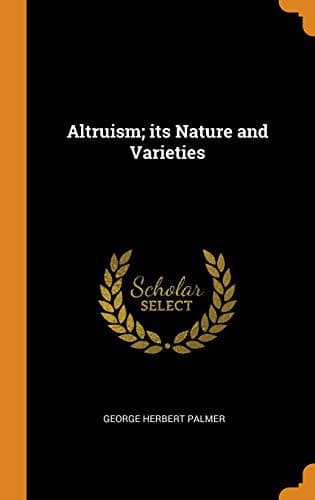
Altruism: Its Nature and VarietiesPalmer, George Herbert
Philosophy
Altruism: Its Nature and Varieties
Palmer, George Herbert
Altruism
Love is so often proclaimed as a social panacea that I have thought it
well to subject it to a careful criticism and indicate its defects when
regarded as a complete embodiment of altruism. Some of those defects
are incidental. Since it is an affair of human beings it cannot fail to
show the imperfections characteristic of such wayward creatures. Seldom
does even marriage, love’s best opportunity, attain that full mutuality
which I have eulogized. Self-assertion intrudes early. The interests
of one or the other party become predominant, and mutuality gradually
declines. When the simple-minded man was told that in marriage two
persons become one, he naturally enough asked: “Which one?” Yet if
the completely conjunct life is rare, it is precious as an ideal for
directing conduct. We often speak of love as something we fall into.
Rather it is something to be made, developed, steadily approximated.
The best marriages are accomplished works of art, yielding large
rewards through all their progressive stages. But love is ever
unstable. Unwatched, it slips down among the lower forms of altruism.
These defects of love are, however, but incidental and such as are
common in all man’s undertakings. There is nothing in love which can
render it immune from human infirmity. But there are also in it certain
fundamental defects which prevent it from becoming an organizing
world-principle. At least before it can weld individuals into societies
and states it must undergo large transformation and appear rather as
justice than domestic affection. For love is naturally selective and
individual, picking out one and rejecting another. It does not offer
its bounty alike to all. Private altruism, it might be called, so that
it always seems indelicate to speak of it in public. It concerns only
those immediately involved and only their most intimate experiences.
From such limitations it needs to be freed before it can become
formative over society. All that is conjunctive in it must be retained
and only its exclusions removed. In this way general justice will
supplement individual love. All the varieties of mutuality are alike in
joining self-regard with extra-regard. They differ only in the extent
of that extra-regard.
Public-domain text, read in full here on John Shaqi.
Reviews
Reviews
No reviews yet
Be the first to share your thoughts on this work.
Join the Discussion
Join the discussion
Sign in to leave a comment or review.
Sign InorCreate an account