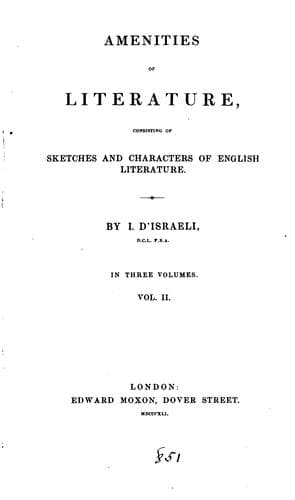
Amenities of Literature: Consisting of Sketches and Characters of English LiteratureDisraeli, Isaac
History
Amenities of Literature: Consisting of Sketches and Characters of English Literature
Disraeli, Isaac
Authors, English -- Biography; English literature -- History and criticism; Great Britain -- Intellectual life
The "Saxon Chronicle," which closes with the year 1155, had been
continued at progressive intervals by different writers; this authentic
document of the Anglo-Saxon diction exhibits remarkable variations of
style; and a critical Saxonist has detected the corruptions of its
idiom, its inflections, and its orthography--in a word, that through
successive periods it had suffered a material alteration in its
character.[2]
Somewhat more than a century after the Norman invasion, about 1180,
Layamon made an English version of Wace's "Brut"--that French metrical
chronicle which the Anglo-Norman had drawn from the Latin history of
"Geoffry of Monmouth." Here we detect an entire changeableness of style,
or rather a transformation; but what to call it the most skilful have
not agreed. George Ellis drew a copious specimen of a writer unnoticed
by Warton; but, confounded by "its strange orthography," and mournfully
doubtful of his own meritorious glossary, he considered the style,
"though simple and unmixed, yet a very barbarous Saxon." A recent critic
opines that Layamon "seems to have halted between two languages, the
written and the spoken." Mr. Campbell imagines it "the dawn" of our
language; while some Saxonists have branded it as semi-Saxon. It seems a
language thrown into confusion, struggling to adapt itself to a new
state of things; it has no Norman-French, it is saturated with Saxon,
but the sentences are freed from inversions.[3]
About the same period as Layamon's version of Wace, we have a very
original attempt of a writer, in those days of capricious pronunciation,
to convey to the reader the orthoepy by regulating the orthography. As
it is only recently that we have obtained any correct notion of a
writing which has suffered many misconceptions from our earlier English
scholars, the history of this work becomes a bibliographical curiosity.
An ecclesiastic paraphrased the Gospel-histories. He was a critical
writer, projecting a system to which he strictly adhered, warning his
transcribers as punctually to observe, otherwise "they would not write
the word right;" they were therefore "to write those letters twice which
he had written so." The system consisted in doubling the consonant after
a short vowel to regulate the pronunciation. He wrote broth_err_ and
afft_err_; is _iss_, and it _itt_.[4]
Public-domain text, read in full here on John Shaqi.
Reviews
Reviews
No reviews yet
Be the first to share your thoughts on this work.
Elsewhere in the archive
Join the Discussion
Join the discussion
Sign in to leave a comment or review.
Sign InorCreate an account