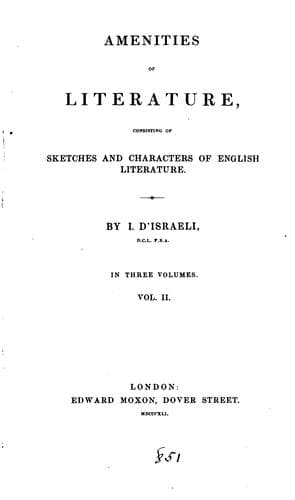
Amenities of Literature: Consisting of Sketches and Characters of English LiteratureDisraeli, Isaac
History
Amenities of Literature: Consisting of Sketches and Characters of English Literature
Disraeli, Isaac
Authors, English -- Biography; English literature -- History and criticism; Great Britain -- Intellectual life
"I wrote
In symple speeche as I couthe,
That is _lightest in manne's mouthe_.
I mad (made) nought for no disoúrs (tale-tellers),
Ne for no seggers nor harpoúrs,
Bot for the luf (love) of symple menu
That _strange Inglis_ cann not ken."
It was about this time that the metrical romances, translated from the
French, spread in great number, and introduced many exotic phrases. In
the celebrated romance of "Alisaundre" we find French expressions,
unalloyed by any attempt at Anglicising them, overflowing the page. The
phrase is, however, once applied to certain strange metres which our
monk avoided, for many "that read English would be confounded by them."
Whatever Robert de Brunne might allude to by his "strange Ingliss,"[9]
the same cry and the identical expressions are repeated by a writer not
many years afterwards--RICHARD ROLLE, called "the Hermit of Hampole." He
produced the earliest versions of the Psalms into English prose, with a
commentary on each verse; and a voluminous poem in ten thousand lines,
entitled "The Prikke of Conscience," translated from the Latin for "the
unletterd men of Engelonde who can only understand English." In the
prologue to this first Psalter in English prose he says, "I seke no
_straunge Ynglyss_, bot _lightest_ and _communest_, and wilk (such) that
is most like unto the Latyn; and thos I fine (I find) no proper Inglis I
felough (follow) the wit of the words, so that thai that knowes noght
(not) the Latyne, be (by) the Ynglys may come to many Latyne wordys."
Here we arrive at open corruption! Already a writer appears refined
enough to complain of the poverty of the language in furnishing "proper
Inglis" or synonymes for the Latin; the next step must follow, and that
would be in due time the latinising "the Ynglys."
A great curiosity of the genuine homeliness of our national idiom at
this time has come down to us in a manuscript in the Arundel
Collection, now in our national library. It is a volume written by a
monk of St. Austin's at Canterbury, in the Kentish dialect, about a
century and a half after Layamon, and half a century after Robert of
Gloucester, in 1340. This honest monk, like others of the Saxon
brotherhood, was writing for his humbled countrymen, or, as he expresses
himself, with a rude Doric simplicity,
Vor Vader and for Moder and for other Ken.
Public-domain text, read in full here on John Shaqi.
Reviews
Reviews
No reviews yet
Be the first to share your thoughts on this work.
Elsewhere in the archive
Join the Discussion
Join the discussion
Sign in to leave a comment or review.
Sign InorCreate an account