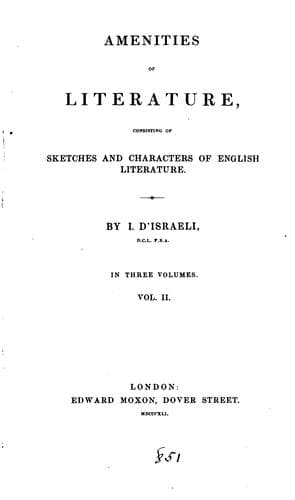
Amenities of Literature: Consisting of Sketches and Characters of English LiteratureDisraeli, Isaac
History
Amenities of Literature: Consisting of Sketches and Characters of English Literature
Disraeli, Isaac
Authors, English -- Biography; English literature -- History and criticism; Great Britain -- Intellectual life
Nearly a century after Layamon, in the same part of England, the monk,
ROBERT OF GLOUCESTER, wrote his "Chronicle," about 1280. This honest
monk painfully indited for his brother-Saxons the whole history of
England, in the shape of Alexandrine verse in rhyme; the diction of the
verse approaches so nearly to prose, that it must have been the
colloquial idiom of the west. The "Ingliss," as it was called in the
course of the century between Layamon and Robert of Gloucester, betrays
a striking change; and modern philologists have given the progressive
term of "middle English" to the language from this period to the
Reformation.[6] Our chronicler has fared ill with posterity, of whom
probably he never dreamt. Robert of Gloucester, who is entirely divested
of a poetical character, as are all rhyming chroniclers, has had the
hard hap of being criticised by two merciless poets; and, to render his
uncouthness still more repulsive, the black-letter fanaticism of his
editor has vauntingly arrayed the monk whom he venerated in the sable
Gothic, bristling with the Saxon characters.[7] It has therefore
required something like a physical courage to sit down to Robert of
Gloucester. Yet in the rhymer whom Warton has degraded, Ellis has
discovered a metrical annalist whose orations are almost eloquent, whose
characters of monarchs are energetic, and what he records of his own age
matter worthy of minute history.
Another monk, ROBERT MANNYNG, of Brunne, or Bourne, in Lincolnshire, who
had versified PIERS LANGTOFT'S "Chronicle," has left a translation of
the "Manuel des Péchés," ascribed to Bishop Grosteste, who composed it
in politer French. In this "Manual of Sins," or, as he terms it, "A
Handlyng of Sinne," according to monkish morality and the monkish
devices to terrify sinners, our recreative monk has introduced short
tales, some grave, and some he deemed facetious, which convey an idea of
domestic life and domestic language. It is not without curiosity that we
examine these, the earliest attempts at that difficult trifle--the art
of telling a short tale, Robert de Brunne is neither a Mat Prior nor a
La Fontaine, but he is a block which might have been carved into one or
the other, and he shows that without much art a tale may be tolerably
told.[8] His octosyllabic verse is more fluent than the protracted
Alexandrine of his "Chronicle." The words fall together in natural
order, and we seem to have advanced in this rude and artless "Ingliss."
But the most certain evidence that "the English" was engaging the
attention of those writers who professedly were devoting their pens to
those whom they called "the Commonalty," is, that they now began to
criticise; and we find Robert de Brunne continually protesting against
"strange Ingliss." This phrase has rather perplexed our inquirers.
"Strange Ingliss" would seem to apply to certain novelties in diction
used by the tale-reciters and harpers, for so our monk tells us,
Public-domain text, read in full here on John Shaqi.
Reviews
Reviews
No reviews yet
Be the first to share your thoughts on this work.
Elsewhere in the archive
Join the Discussion
Join the discussion
Sign in to leave a comment or review.
Sign InorCreate an account