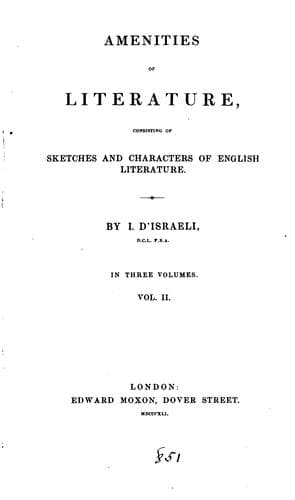
Amenities of Literature: Consisting of Sketches and Characters of English LiteratureDisraeli, Isaac
History
Amenities of Literature: Consisting of Sketches and Characters of English Literature
Disraeli, Isaac
Authors, English -- Biography; English literature -- History and criticism; Great Britain -- Intellectual life
Three centuries had now passed, and still the national genius languished
in the Norman bondage of the language. But the commonalty were
increasing in number and in weight, and an indignant sense of the
destitution of a national language was not confined to the laity; it was
attracting the attention of those who thought and who wrote. Richard of
Bury, Bishop of Durham, who put forth the first bibliographical treatise
by an Englishman, and may he ranked among the earliest critical
collectors of a private library, in his celebrated treatise on the love
of books, the "Philo-biblion,"[13] breathes all the enthusiasm of study;
but while he directs our attention to the classical writers of
antiquity, he stimulates his contemporaries to emulate them by composing
new books. Although he himself wrote in Latin, he regrets that no
institution for children in the English language existed; and he
complains, that our English youth "first learned the French, and from
the French the Latin." Our youth were sent into France to polish their
nasal Norman. This writer flourished about 1330, and thus ascertains,
that in the beginning of the reign of Edward III. no English was taught.
The "Polychronicon," a Latin chronicle compiled by the monk Higden, was
finished somewhat later, about 1365; and we find the complaint more
bitterly renewed. "There is no nation," wrote this honest monk, "whose
children are compelled to leave their own language, as we have since the
Normans came into England. A gentleman's child must speak French from
the time that he is rocked in a cradle, or plays with a child's breche."
The Latin Chronicle of Higden, twenty years later, was translated into
English by John de Trevisa. On this passage the translator furnishes the
important observation, that, since this was written, a revolution had
occurred through our grammar-schools: the patriotic efforts of one Sir
John Cornewaile, in teaching his pupils to construe their Latin into
English, had been generally adopted; "so that now," proceeds Trevisa,
"the yere of our Lorde 1385, in all the grammere scoles of Engelond,
children leaveth Frensche and construeth and lerneth in Englische." The
innovation had startled our translator, for, like all innovations, there
was loss as well as profit, when, quitting what we are accustomed to,
we launch dubiously into a new acquisition. The disuse of the French
would detriment their intercourse abroad, and, on great occasions, at
home. This was a time when Trevisa himself, in selecting some Scriptural
inscriptions for the chapel of Berkley Castle, where he was chaplain,
had them painted on boards in Norman-French, and Latin, in alternate
lines. They are still visible. English itself was yet too base for the
service of God.
Public-domain text, read in full here on John Shaqi.
Reviews
Reviews
No reviews yet
Be the first to share your thoughts on this work.
Elsewhere in the archive
Join the Discussion
Join the discussion
Sign in to leave a comment or review.
Sign InorCreate an account