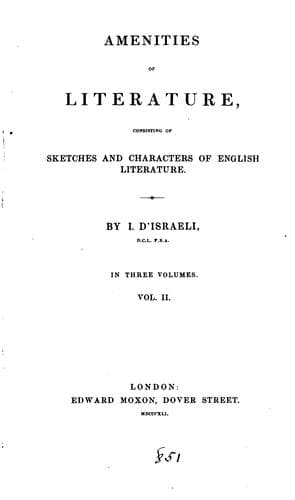
Amenities of Literature: Consisting of Sketches and Characters of English LiteratureDisraeli, Isaac
History
Amenities of Literature: Consisting of Sketches and Characters of English Literature
Disraeli, Isaac
Authors, English -- Biography; English literature -- History and criticism; Great Britain -- Intellectual life
It was still a debateable question, as appears by the prefatory dialogue
between Trevisa and his patron, Lord Berkley, whether any translation of
the Chronicle were at all necessary, Latin being the general language.
It was, however, a noble enterprise, being the first great effort in our
vernacular prose. This mighty volume is a universal history, which, in
its amplitude and miscellaneous character, seemed to contain all that
men could know; and the version long enjoyed the favour of all readers
as the first historical collection in the English language. It bears the
seal of the monkish taste, being equally pious and fabulous. It not only
opens before the days of Adam, but, like the creation, has its seven
divisions; it has monsters, however, which are not found in Genesis. The
monk is doubtful whether they came of Adam or of Noah. They, indeed,
came from the elder Pliny, to whose puerile wonders and hasty
compilation we owe the foundation of our natural history.
It was about the period that Higden concluded his labours, that Sir John
Mandeville deemed it wise, having written his Travels in Latin and
French, to compose them also in the vernacular idiom;--a strong
indication of the rising disposition to cultivate the national tongue.
The policy of our Government now accorded with the general disposition;
and hence originated the noble decision of Edward III., in 1362, to
banish from our courts of law the Norman-French; but so awkward seemed
this great novelty, that the statute is written in the very language it
abolishes,[14] and, indeed, to which our great lawyers, the timid
slaves of precedents, long afterwards clung in their barbarous
law-French phrases mingled with their native English.
A mightier movement even than the royal decree in favour of fostering
the national language was a translation of the Scriptures, by the
intrepid spirit of Wickliffe. This had been done with the pledge of his
life, for that was often in peril while he thus struck the first impulse
of that reformation which not only influenced his own age, but one more
remote. The translation of Wickliffe was a new revelation of the Word of
God in the language of many. The streets were crowded with Lollards, as
his followers were denominated, of which, like similar odious names
attached to a rising party, the origin remains uncertain; Lollardy was,
however, a convenient term to describe treason in the Church and the
State. Wickliffe's translation of the Old Testament still lies in
numerous manuscripts, for our cold neglect of which we have incurred the
censure of the foreigner. The New Testament has happily been
printed.[15]
If we place by the side of the text of Wickliffe our later versions, we
may become familiar with that Saxon-English which our venerable Caxton
subsequently considered was "more like to Dutch than English."
Public-domain text, read in full here on John Shaqi.
Reviews
Reviews
No reviews yet
Be the first to share your thoughts on this work.
Elsewhere in the archive
Join the Discussion
Join the discussion
Sign in to leave a comment or review.
Sign InorCreate an account