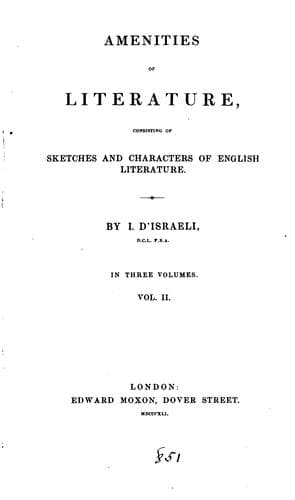
Amenities of Literature: Consisting of Sketches and Characters of English LiteratureDisraeli, Isaac
History
Amenities of Literature: Consisting of Sketches and Characters of English Literature
Disraeli, Isaac
Authors, English -- Biography; English literature -- History and criticism; Great Britain -- Intellectual life
recent critic[20] has curiously calculated that the English language,
now consisting of about 38,000 words, contains 23,000, or nearly
five-eighths, Anglo-Saxon in their origin; that in our most idiomatic
writers, there is about one-tenth _not_ Anglo-Saxon, and in our least
about one-third.[21] A cry of our desertion of our Saxon purity has
been raised by those who have not themselves practised it in their more
elevated compositions; but are we to deem that English corrupted which
recedes from its Saxon character, and compels the daughter to lose the
likeness of her mother? Are we to banish to perpetuity those foreigners
who have already fructified our Saxon soil? In an age of extended
literature, conversant with objects and productive of associations which
never entered into the experience of our forefathers, the ancient
language of the people must necessarily prove inadequate; a new language
must start out of new conceptions. Look into our present "exchequer of
words;" there lies many a refined coinage struck out of the arts and the
philosophies of Europe. Every word which genius creates, and which time
shall consecrate, is a possession of the language which must be
inscribed into that variable doomsday book of words--the English
Dictionary. Devotees of Thor and Woden! the day of your idolatries has
passed, and your remonstrances are vain as your superstitions.
FOOTNOTES:
[1] Mr. Hallam.
[2] Dr. Bosworth.
[3] Of this recondite writer Ellis has said, "probably Layamon never
will be printed;" but we live in an age of publication, and Layamon
is said to be actually in the press. [Since this was written, the
work has been published at the cost of the Society of Antiquaries,
under the editorial care of Sir Frederick Madden.]
[4] Dr. Bosworth, or Mr. Thorpe, has explained this attempt more
fully. "From this idea of doubling the consonant after a short vowel,
as in German, we are enabled to form some tolerably accurate notions
as to the pronunciation of our forefathers. Thus, Orm (or Ormin)
writes _min_ and _win_ with a single _n_ only, and _lif_ with a
single f, because the i is long, as in _mine_, _wine_, and _life_. On
the other hand, wherever the consonant is doubled, the vowel
preceding is sharp and short, as _winn_, pronounced _win_, not
_wine_."--"Origin of the Germanic and Scandinavian Languages," 24.
[5] Guest's "Hist. of English Rhythms," ii. 186.
[6] During the thirteenth century, the organic change proceeded so
rapidly that there is quite as wide a difference between the language
of Layamon and that which was written at the beginning of the
fourteenth century (about the time of Robert of Gloucester), as there
is between the English language of the reign of Edward the Second and
the tongue of the present day.--See Mr. Wright's learned "Essay on
the Literature of the Anglo-Saxons," 107.
Public-domain text, read in full here on John Shaqi.
Reviews
Reviews
No reviews yet
Be the first to share your thoughts on this work.
Elsewhere in the archive
Join the Discussion
Join the discussion
Sign in to leave a comment or review.
Sign InorCreate an account