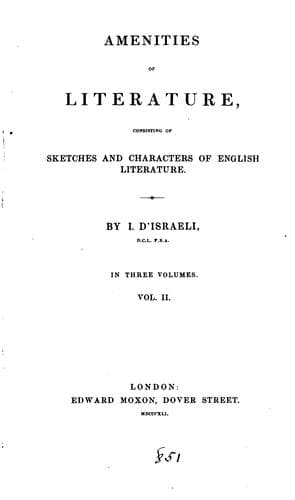
Amenities of Literature: Consisting of Sketches and Characters of English LiteratureDisraeli, Isaac
History
Amenities of Literature: Consisting of Sketches and Characters of English Literature
Disraeli, Isaac
Authors, English -- Biography; English literature -- History and criticism; Great Britain -- Intellectual life
[9] This term of "strange Ingliss" has yet been found so obscure as
to occasion some strictures, which, like the Interpreter in the
Critic, are the most difficult to comprehend. I must refer to
Monsieur Thierry's very delightful "History of the Conquest of
England," ii. 271, for a very refined speculation on our Robert de
Brunne's unlucky obscurity. Monsieur Thierry imagines that the
"strange Ingliss" was the refined English which had flown into
Scotland, and there become the cultivated language of the minstrels
and the court, and which our hapless Saxons on _this side of the
Tweed_ had sunk into a dialect only fitted for serfs. This finer and
more elevated English could not be understood by a base commonalty;
this was "strange Ingliss" to them. A very interesting event in the
history of both nations had transplanted the purer English to the
Scottish court:--Malcolm, whom the usurpation of Macbeth had driven
from the Scottish throne, was expatriated in England during an
interval of near twenty years; the affection of the monarch for the
English was such, that he adopted their language, and when the royal
family of England was expelled by the Conqueror, the king received
them and the emigrant Saxons, and married the English princess. This
gave rise to that intercourse with the south of Scotland, of which
the result in our literary, if not in our civil, history is
remarkable. Certain it is that much broad Scotch is good old English,
and the noblest minstrelsy cometh "fra the North Countrie."
[10] On the leaf appears, in the handwriting of the author, "This Boc
is Dan Michelis of Northgate ywrite an Englis of his ozene hand that
hatte _Ayenbyte of inwyt_, and is of the boc-house of Seynt Austyn's
of Cantorberi." The writer was seventy years of age; and he tells us
that he was not--
"Blind, and dyaf, and alsuo dumb,
Of zeventy yer al not rond,
Ne ssette by draze to the grond,
Uor peny nor mark, ne nor pond."
At the end the monk tells us for whom he writes--
"Nou ich wille that ye ywite hou hitt is ywent
Thet this Boc is ywrite mid Engliss of Kent.
This Boc is ymade vor lewede men,
Vor Vader and vor Moder and vor other Ken,
Ham vor to berze uram alle manyere Zen
Thet ine have inwytte ne bleue no uoul wen.
Huo ase God is his name yzed
Thet this Boc made God him yeue that bread
Of Angles of Hauene and thereto his red,
And underuongè his Zoule, huanne that is dyad."
Public-domain text, read in full here on John Shaqi.
Reviews
Reviews
No reviews yet
Be the first to share your thoughts on this work.
Elsewhere in the archive
Join the Discussion
Join the discussion
Sign in to leave a comment or review.
Sign InorCreate an account