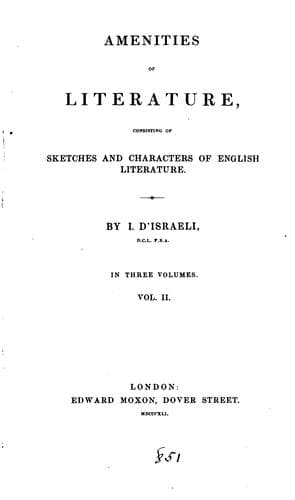
Amenities of Literature: Consisting of Sketches and Characters of English LiteratureDisraeli, Isaac
History
Amenities of Literature: Consisting of Sketches and Characters of English Literature
Disraeli, Isaac
Authors, English -- Biography; English literature -- History and criticism; Great Britain -- Intellectual life
[11] While Tyrwhit was busied on the "Canterbury Tales" his attention
was excited by the old cataloguer of the Cottonian manuscripts to a
_Chaucer exemplar emendate scriptum_. On a spare leaf the name of
Richard Chawfer had been scrawled, which might have been that of some
former possessor. There are two fatalities which hang over the pen of
a slumbering cataloguer--ignorance and indolence. Our present one
caught an immortal name and never travelled onwards; and, struck by
the fairness of the writing, inferred that it was a copy of Chaucer
critically accurate. It turned out to be the compositions of an
unknown poet who not willingly relinquished his claim on posterity,
for he has subscribed his name, LAURENCE MINOT. [The manuscript is
marked Galba, E. IX.; specimens were first published from it by
Tyrwhit and Warton, and the entire series ultimately by Ritson.]
[12] Ritson's first edition (1795) of Minot having become very
difficult to procure, an elegant re-impression, and apparently a
correct one, was published in 1825.
[13] "Philobiblion, sive de Amore Librorum et Institutione
Bibliothecæ," ascribed to Richard of Bury, Bishop of Durham; but
Fabricius says it was written by Robert Holcot, a learned friar, at
his desire.--Fab. "Bib. Med. Ævi," vol. i. It is the bishop, however,
who was the collector, and always speaks in his own person. It has
been recently translated by Mr. Inglis.
[14] Barrington on the Statutes.
In Blackstone's "Commentaries," book iii. chap. 21, we find much
curious information, and some philosophical reflections. The use of
the technical law-Latin is adroitly defended. Under Cromwell the
records were turned into English; at the Restoration the practisers
declared they could not express themselves so significantly in
English, and they returned to their Latin. In 1730, a statute ordered
that the proceedings at law should be done into English, that the
common people might understand the process, &c. But after many years'
experience the people are as ignorant in matters of law as before,
and suffer the inconveniences of increasing _the expense of all legal
proceedings_ by being bound by the stamp-duties to write only a
stated number of words in a sheet, _and the English language, through
the multitude of its particles, is so much more verbose than the
Latin, that the number of sheets is much augmented_. Two years
subsequently it was necessary to make a new act to allow all
technical terms to continue Latin, which were too ridiculous to be
translated, such as _nisi prius, fieri facias, habeas corpus_. This
last act, in 1732, has defeated every beneficial purpose intended by
the preceding statute of 1730.
Public-domain text, read in full here on John Shaqi.
Reviews
Reviews
No reviews yet
Be the first to share your thoughts on this work.
Elsewhere in the archive
Join the Discussion
Join the discussion
Sign in to leave a comment or review.
Sign InorCreate an account