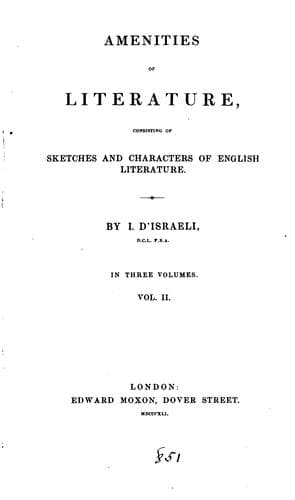
Amenities of Literature: Consisting of Sketches and Characters of English LiteratureDisraeli, Isaac
History
Amenities of Literature: Consisting of Sketches and Characters of English Literature
Disraeli, Isaac
Authors, English -- Biography; English literature -- History and criticism; Great Britain -- Intellectual life
"Our English tongue driven almost out of kind (nature),
Dismember'd, hack'd, maim'd, rent, and torn,
Defaced, patch'd, marr'd, and made in scorn."
A critic who has left us "An Arte of English Poetry," written perhaps
about 1550 or 1560, exhorting the poet to render his language, which,
however, he never could in his own verses, "natural, pure, and the most
usual of all his country," seemed at a loss where to fix on the standard
of style. He would look to the Court to be the modellers of speech, but
there he acknowledges that "the preachers, the secretaries, and
travellers," were great corrupters, and not less "our Universities,
where scholars use much peevish affectation of words out of the
primitive languages." The coarse bran of our own native English was,
however, to be sifted; but where was the genuine English idiom to be
gathered? Our fastidious critic remonstrates against "the daily talk of
northern men." The _good southern_ was that "we of Middlesex or Surrey
use." Middlesex and Surrey were then to regulate the idiom of all
British men! and all our England was doomed to barbarism, as it varied
from "the usual speech of the Court, and that of London within sixty
miles, and not much above." But was our English more stable within this
assigned circumference of the metropolis than any other line of
demarcation? About 1580, CAREW informs us that "Within these sixty years
we have incorporated so many Latin and French words as the third part of
our language consisteth in them."
Some there were among us who, alarmed that such ceaseless infusions were
polluting the native springs of English, would look back with veneration
and fondness on our ancient masters. Our great poet SPENSER,[6] then
youthful, declared that the language of CHAUCER was the purest English;
and our bard hailed, in a verse often quoted by the critics--
Dan Chaucer, well of English undefiled.
But in this well are deposited many waters. Chaucer has been accused of
having enriched the language with the spoils of France, blending the old
Saxon with the Norman-French and the modern Gallic of his day, for which
he has been vehemently censured by the austerity of philological
antiquaries. Skinner and his followers have condemned Chaucer for
introducing "a waggon-load of words," and have proclaimed that Chaucer
"wrote the language of no age;" a reproach which has been transferred to
our Spenser himself, who has transplanted many an exotic into the
English soil, and re-cast many an English word for the innocent forgery
of a rhyme! So that two of the finest geniuses in our literature, for
recasting the language, must lay their heads down to receive the heavy
axe of verbal pedantry.
Public-domain text, read in full here on John Shaqi.
Reviews
Reviews
No reviews yet
Be the first to share your thoughts on this work.
Elsewhere in the archive
Join the Discussion
Join the discussion
Sign in to leave a comment or review.
Sign InorCreate an account