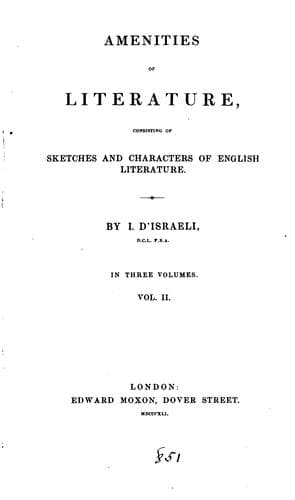
Amenities of Literature: Consisting of Sketches and Characters of English LiteratureDisraeli, Isaac
History
Amenities of Literature: Consisting of Sketches and Characters of English Literature
Disraeli, Isaac
Authors, English -- Biography; English literature -- History and criticism; Great Britain -- Intellectual life
"Our own tongue should be written _clean_ and _pure_, unmixt and
unmangled with borrowing of other tongues, wherein, if we take not heed,
by time, ever borrowing and never paying, she shall be fain to keep her
house as bankrupt. For then doth our tongue naturally and praisably
utter her meaning, when she borroweth no counterfeitness of other
tongues to attire herself withal; but used plainly her own, with such
shift as nature, craft, experience, and following of other excellent,
doth lead her unto; and if she want at any time (as, being imperfect,
she must), yet let her borrow with such bashfulness that it may appear,
that if either the mould of our own tongue could serve us to fashion a
word of our own, or if the old denizened words could content and ease
this need, we would not boldly venture on unknown words. This I say, not
for reproof of you, who have scarcely and necessarily used, where
occasion seemeth, a strange word so, as it seemeth to grow out of the
matter, and not to be sought for; but for my own defence, who might be
counted overstraight a deemer of things, if I give not this account to
you, my friend, of my marring this your handy work."
Such was the tone even of our primitive critics! the terrors of
neologism were always before their eyes. All those accessions of the
future opulence of the vernacular language were either not foreseen or
utterly proscribed, while, at the same time, the wants and imperfections
of the language, amid all its purity or its poverty, were felt and
acknowledged. We perceive that even this stern champion of his
vernacular idiom confesses that "he may want at time, being imperfect,
and must borrow with bashfulness." The cries of the critics suddenly
break on us. Another contemporary critic of not inferior authority
laments that "there seemed to be no mother-tongue." "The far-journeyed
gentlemen" returned home not only in love with foreign fashions, but
equally fond "to powder their talk with over-sea language." There was
French-English, and English Italianated. Professional men disfigured the
language by conventional pedantries; the finical courtier would prate
"nothing but Chaucer." "The mystical wisemen and the poetical clerks
delivered themselves in quaint proverbs and blind allegories."[5] The
pedantic race, in their furious Latinisms, bristling with polysyllabic
pomposity, deemed themselves fortunate when they could fall upon "dark
words," which our critic aptly describes "catching an ink-horn term by
the tail." The eloquence of the more volatile fluttered in the splendid
patches of modern languages. It seemed as if there were to be no longer
a native idiom, and the good grain was choked up by the intruding cockle
which flourished by its side. Another contemporary critic announces that
"our English tongue was a gallimaufry or hodge-podge of all other
speeches." ARTHUR GOLDING grieves over the disjected members of the
language:--
Public-domain text, read in full here on John Shaqi.
Reviews
Reviews
No reviews yet
Be the first to share your thoughts on this work.
Elsewhere in the archive
Join the Discussion
Join the discussion
Sign in to leave a comment or review.
Sign InorCreate an account