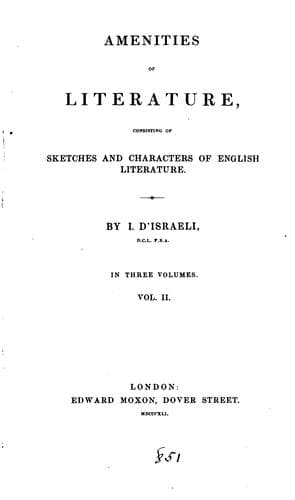
Amenities of Literature: Consisting of Sketches and Characters of English LiteratureDisraeli, Isaac
History
Amenities of Literature: Consisting of Sketches and Characters of English Literature
Disraeli, Isaac
Authors, English -- Biography; English literature -- History and criticism; Great Britain -- Intellectual life
But let us not quit this topic of "purity of style" without offering our
sympathies for those who have suffered martyrdom in their chimerical
devotion. In the days of my youth there were some who would not write a
word unwarranted by Swift or Tillotson; these were to be held fast for
pure idiomatic prose, by those who felt insulted by the encumbering
Lexiphanicisms of the ponderous numerosity of Johnson; and recently a
return to our Saxon words, diminutive in size, has been trumpeted in a
set oration at the University of Glasgow by a noble personage. This
taste is rife among critics of limited studies. Charles Fox, a fine
genius who turned towards the pursuits of literature too late in life,
was a severe sufferer, and purified his vocabulary with a scrupulosity
unknown to any purist, so nervously apprehensive was this great man lest
he should not write English. Addison, Bolingbroke, and Middleton were
not of sufficient authority, for he would use no word which was not to
be found in Dryden. Alas! what disappointments await the few who creep
along their Saxon idiom, or who would pore on the free gracefulness of
Dryden as a dictionary of words and phrases! Could the chimerical purity
which these are in search of be ever found, never would it lend
enchantment to their page, should their taste be cold or their fancy
feeble. The language of genius must be its own reflection, and the good
fortune of authors must receive the stamp used in their own mint.
It happens with the destiny of words, as in the destiny of empires. Men
in their own days see only the beginnings of things, and more sensibly
feel the inconvenience of that state of transition inflicted by
innovation, in its first approaches often capricious, always empirical.
These vicissitudes of language in their end were to produce a vernacular
idiom more wealthy than our native indigence seemed to promise. All
those vehement cries of the critics which we have brought together were
but the sharp pangs and throes of a parturient language in the natural
progress of a long-protracted birth.
A national idiom in its mighty formation, struggling into its perfect
existence, encumbered by the heavy mass in which it lies involved,
resembles the creation of the lion of the Bard of Paradise, when
--------Half appear'd
The tawny Lion, PAWING TO GET FREE
HIS HINDER PARTS.
FOOTNOTES:
[1] "Curiosities of Literature," Art. "HISTORY OF NEW WORDS."
[2] These are political squibs thrown out by the mobocracy in the
reign of Richard the Second. They are preserved in Mr. Turner's
"History of England." I print them in their modern orthography. The
first specimen runs in familiar rhymes:--
Public-domain text, read in full here on John Shaqi.
Reviews
Reviews
No reviews yet
Be the first to share your thoughts on this work.
Elsewhere in the archive
Join the Discussion
Join the discussion
Sign in to leave a comment or review.
Sign InorCreate an account