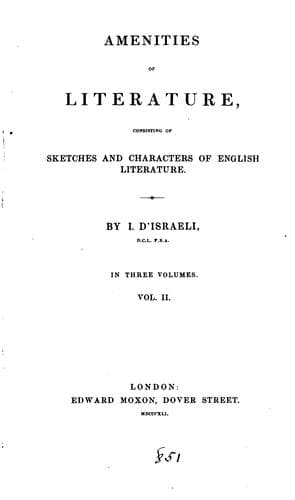
Amenities of Literature: Consisting of Sketches and Characters of English LiteratureDisraeli, Isaac
History
Amenities of Literature: Consisting of Sketches and Characters of English Literature
Disraeli, Isaac
Authors, English -- Biography; English literature -- History and criticism; Great Britain -- Intellectual life
"Jack the Miller asked help to turn his mill aright. He hath ground
small, small! The King's son of Heaven he shall pay for all. Look thy
Mill go aright with the four sails, and the post stand in
steadfastness. With Right and with Might, with Skill and with Will,
let Might help Right, and Skill go before Will, and Right before
Might, then goes our Mill aright, and if Might go before Right, and
Will before Skill, then is our Mill mis adyght."
Now we have plain, intelligible prose--
"Jack Carter prays you all that ye make a good end of that ye have
begun, and do well, and still better and better; for at the even men
near the day. If the end be well, then is all well. Let Piers the
ploughman dwell at home, and dyght us corn. Look that Hobbe the
robber be well chastised. Stand manly together in truth, and help the
truth, and truth shall help you."
[3] Sir Francis Palgrave's "Rise and Progress of the English Common
wealth;" Proofs and Illustrations, ccxiii.
[4] This letter to the translator Hoby has been passed over by those
who collected the few letters of the learned CHEKE; and, what seems
strange, appears only in the first edition of Hoby's translation,
having been omitted in the subsequent editions. Perhaps the
translator was not enamoured of his excellent critic.
[5] Sir Thomas Wilson's "Arte of Rhetoric," 1553.
[6] Spenser's protest against the Innovators of Language may be seen
in his "Three Letters," which are preserved unmutilated in Todd's
"Spenser;" they are deficient in Hughes' edition.
[7] Heylin's "Observations on the Historie of the Reign of King
Charles." L'Estrange's rejoinder may be found in the second edition
of his History.
[8] "Alvearie, or quadruple Dictionary of Four Languages," 1580.
[9] "The English Dictionary, or an Interpreter of Hard English
Words," by H. C., gent., 1658. The eleventh and twelfth editions are
before me. The last, edited by another person, is not so copious as
the former. In Cockram's own edition we have a first "Book" of his
"Hard Words," followed by a second of what he calls "Vulgar Words,"
which are English. The last editor has wholly omitted the second
part. Of the first part, or the "Hard Words," Cockram observes that
"They are the _choicest words now in use_, and wherewith our language
is enriched and become so copious, to which words the common sense is
annexed." [See note on this Dictionary, with some few specimens of
its contents, in "Curiosities of Literature," vol. iii.]
DIALECTS.
Dialects reflect the general language diversified by localities.
Public-domain text, read in full here on John Shaqi.
Reviews
Reviews
No reviews yet
Be the first to share your thoughts on this work.
Elsewhere in the archive
Join the Discussion
Join the discussion
Sign in to leave a comment or review.
Sign InorCreate an account