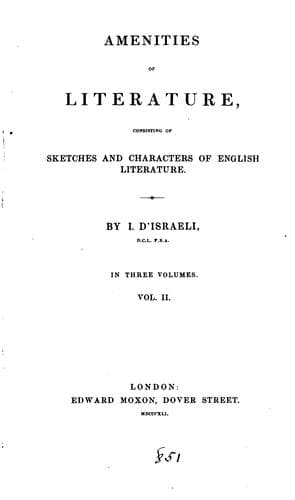
Amenities of Literature: Consisting of Sketches and Characters of English LiteratureDisraeli, Isaac
History
Amenities of Literature: Consisting of Sketches and Characters of English Literature
Disraeli, Isaac
Authors, English -- Biography; English literature -- History and criticism; Great Britain -- Intellectual life
[1] "Dictionnaire Languédocien-françois," par l'Abbé de Sauvages.
"_Franchiman_ est formé de l'Allemand, et signifie _homme de
France_." The Abbé wrote in 1756, when he did not care to translate
too literally; the Frank-man meant the _Free man_, for the Franks
called themselves so, as "the free people." This learned Gascon, in
his zeal for the _Langue d'oc_, explains, "_Parla Franchiman_," means
"parler avec l'accent (bon ou mauvais) des provinces du nord du
royaume:" an insinuation that the French accent might not be
positively the better one. The good Abbé had such a perfect
conviction of the superiority of his Languedocians, that he would
have no other servants not only for their superior integrity, but for
that of their language.
[2] "Palgrave," 174. They also received some in exchange, many words
in Cæsar being British.--Hearne's "Leland's Itinerary," vi.
[3] In that very curious "Logonomia Anglica" of the learned Alexander
Gill--the father, for his son of the same name succeeded him as
master of St. Paul's--we have the orthoepy of our dialects given with
great exactness. This work was produced about 1619, and we find the
peculiar provincial pronunciation of the present day. A work so
curious in the history of our vernacular tongue should not have been
composed in Latin. Mr. Guest has carefully translated a judicious
extract,--"History of English Rhythms," ii, 204.
[4] The late Dr. Valpy told me that Mr. Walker, the orthoepist, had
so intimate a knowledge of the provincial peculiarities of
pronunciation, that in a private course of reading at Oxford with
twelve undergraduates, he told each of them the respective place of
their birth or early education.
[5] Tooke's "Diversions of Purley," p. 141.
[6] In "Anecdotes of the English Language," by Samuel Pegge, an
antiquary, who called himself "an old modern," the reader will find
several curious exemplifications of the vulgar dialect, sometimes
fancifully, but often satisfactorily ascertained. It is amusing to
detect what we call _vulgarisms_ composing the language of Chaucer
and Shakspeare, and even our Bibles and Liturgies.
Public-domain text, read in full here on John Shaqi.
Reviews
Reviews
No reviews yet
Be the first to share your thoughts on this work.
Elsewhere in the archive
Join the Discussion
Join the discussion
Sign in to leave a comment or review.
Sign InorCreate an account