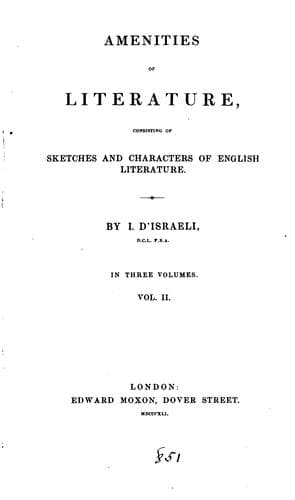
Amenities of Literature: Consisting of Sketches and Characters of English LiteratureDisraeli, Isaac
History
Amenities of Literature: Consisting of Sketches and Characters of English Literature
Disraeli, Isaac
Authors, English -- Biography; English literature -- History and criticism; Great Britain -- Intellectual life
was not aware of the authentic antiquity of our dialectic terms and
phrases. Our literary antiquities had not yet engaged the attention of
general scholars. Provincialisms were not deemed by the legislator of
our language legitimate words; he did not recognise their primitive
claims, nor their relative affinities, but ejected them as vagabonds.
But words are not barbarous nor obsolete because no longer used in our
written composition, since some of the most exquisite and picturesque,
which have ceased to enrich our writings, live in immortal pages. After
the issue of Johnson's great labour, our national literature began to
attract the studies of literary men, who soon perceived how this
neglected but existing stock of idiomatic English in our provincialisms
more certainly explained our elder writers in verse and prose. Amid the
murmurs raised by the archæologists, ASH attempted to supply the
palpable deficiency of Johnson; but the matter was too abundant, and his
space too contracted. In vain he attempted his "Supplement;" all the
counties in England seemed to rise against the luckless glossarist; but
notwithstanding its limited utility, his vocabulary was often preferred
for its copiousness to the more elaborate lexicon. The spirit of inquiry
was now abroad after the "winged words;" and ingenious persons, within
these twenty years,[7] have produced a number of provincial glossaries;
but several are still wanting, particularly those of Kent, and Sussex,
and Hampshire. All these glossaries collected together might form a
provincial lexicon marking each county. A few might be allowed to enter
into the great dictionary of the English language; but that would not be
their safest place, for they would then lie at the mercy of successive
editors, who would not always discern a precious archaism amid the
baseness and corruption of language. The origin, the nature, and the
history of our provincial idioms have yet never been investigated,
though the subject, freed from its mere barbarisms, opens a diversified
field to the philosopher, the antiquary, and the philologist.
Grose, who wrote in 1785, notices the state of those counties which were
remote from the metropolis, or which had no immediate intercourse with
it before "newspapers and stage-coaches imported scepticism, and made
every ploughman and thresher a politician and a freethinker." The
accelerated intercourse of the people has long passed beyond the diurnal
folio and the evanescent stage-coach, and in a century of railroads and
national schools the provincial glossary will finally vanish away.
FOOTNOTES:
Public-domain text, read in full here on John Shaqi.
Reviews
Reviews
No reviews yet
Be the first to share your thoughts on this work.
Elsewhere in the archive
Join the Discussion
Join the discussion
Sign in to leave a comment or review.
Sign InorCreate an account