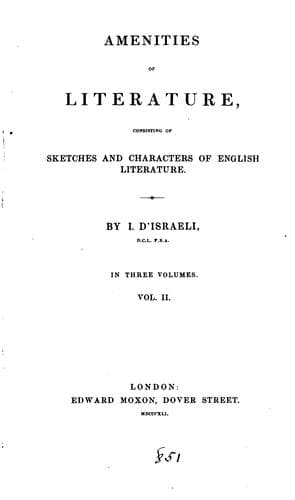
Amenities of Literature: Consisting of Sketches and Characters of English LiteratureDisraeli, Isaac
History
Amenities of Literature: Consisting of Sketches and Characters of English Literature
Disraeli, Isaac
Authors, English -- Biography; English literature -- History and criticism; Great Britain -- Intellectual life
We trace such tales among the romances, with all their circumstances;
and some may have reached the listener from the Arabian tale-teller. The
monsters he describes Mandeville never invented; these, human and
animal, he gave as some of his predecessors had done, from Pliny, or
Ælian, or Ctesias,[1] who have sent them down to be engraven in the
Great Nuremberg Chronicle, and adorned in the immortal page of
Shakspeare. Marco Polo had noticed that portentous bird which could lift
an elephant by its claws; he does not tell us that he had seen any bird
of this wing, but we all know where it is to be found--in the Arabian
Tales! Sir Thomas Browne accuses Mandeville of _confirming_ the fabulous
accounts of India by Ctesias; but, in truth, our knight does not
"confirm these refuted notions of antiquity;" he only repeats them, with
the prelude of "men seyn." No one was more honest than Mandeville, for
when he had to describe the locality of paradise, he fairly acknowledges
that "he cannot speak of it properly, for I was not there; it is far
beyond, but as I have _heard say_ of wise men, it is on the highest
part of the earth, nigh to the circle of the moon." However, he has
contrived to describe the wall, which is not of stone, but of moss, with
but a single entrance, "closed with brennynge fyre;" and though no
mortal could enter, yet it was known that there was a well in paradise,
whence flowed the four floods that run through the earth. "Wise men," he
tells us, said this; some of these "wise men" were the Rabbins; and
three centuries afterwards, the accounts of paradise, by a finer genius
than Mandeville, the illustrious Rawleigh, remained much the same.
To explain some of those incredible incidents which occurred to the
author himself might exercise some critical ingenuity. Mandeville's
adventure in "the Valley Perilous," when he saw the Devil's head with
eyes of flame, great plenty of gold and silver, which he was too
frightened to touch, and, moreover, a multitude of dead bodies, as if a
battle had been fought there, might probably be resolved into some
volcanic eruption, the rest supplied by his own horrifying imagination;
for he tells, with great simplicity, "I was more devout then than ever I
was before or after, and all for the dread of fiends that _I saw in
divers figures_;" that is, at the _shapes_ of the disparted rocks. The
travellers were beaten down by tempests, winds, and thunder, which raged
in this pent-up vale. As he marks the locality, the spot may yet be
ascertained.
Public-domain text, read in full here on John Shaqi.
Reviews
Reviews
No reviews yet
Be the first to share your thoughts on this work.
Elsewhere in the archive
Join the Discussion
Join the discussion
Sign in to leave a comment or review.
Sign InorCreate an account