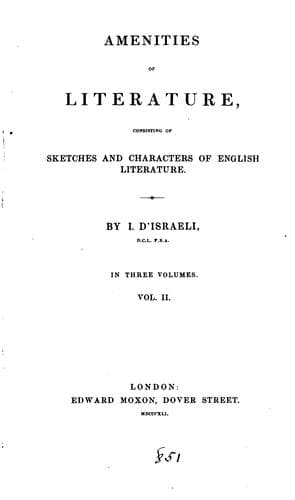
Amenities of Literature: Consisting of Sketches and Characters of English LiteratureDisraeli, Isaac
History
Amenities of Literature: Consisting of Sketches and Characters of English Literature
Disraeli, Isaac
Authors, English -- Biography; English literature -- History and criticism; Great Britain -- Intellectual life
There was no imposition practised in all such legends; it is we who are
startled by the supernatural in a personal narrative; but in the
fourteenth century the more wonderful the tale, the more authentic it
appeared, as it sunk into the softest and richest moulds of the most
germinating imagination. The readers, or the hearers, were as well
prepared to believe, as the writers prompt to gather up, their fictions.
Collections of "Mirabilia Mundi," "Wonders," were a fashionable title
applied to any single country, as well as to the world--to England or
Ireland, to the Holy Land or the Indies. The "Mirabilia" might be the
running title for a whole system of geography. The age of imagination
has long been unfurnished of all its ingenious garniture, and yet we
still catch at some evanescent hour of fancy susceptible of those
ancient delights. We have lost something for which we have no
substitute. Would not the modern novelist rejoice in the privilege of
intermingling supernatural inventions to break the level of his
every-day incidents and his trivial passions so soon forgotten? But that
glowing day has set, leaving none of its ethereal hues in our cold
twilight. Mandeville may still be read for those wild arabesques which
so long unjustly proved fatal to his authentic narrative. His simplicity
often warrants its truth; he assures us that Jerusalem is placed in the
middle of the earth, because when he stuck his staff in the ground,
exactly at noon, it cast no shadow; and having ascertained the spherical
form of the globe, he marvels how the antipodes, whose feet are right
upwards towards us, yet do not fall into the firmament! When he
describes the elegant ornaments of "a vine made of gold that goeth all
about the hall, with many bunches of grapes, some white, and the red
made of rubies," he tells what he had seen in some divan; but when he
records that "the Emperor hath in his chamber a pillar of gold, in which
is a ruby and carbuncle a foot long, which lighteth all his chamber by
night," it may be questioned whether this carbuncle be anything more
than an Arabian fancy, a tale to which he had listened. Some of his
ocular marvels have been confirmed by no questionable authority.
Mandeville's description of a magical exhibition before the Khan of
Tartary is a remarkable instance of the strange optical illusions of the
scenical art, and the adroitness of the Indian jugglers--a similar scene
appears in a recent version of the autobiography of the Emperor Akber.
What seemed the spells of magic to the Europeans of that age, and of
which some marvellous descriptions were brought to Europe by the
crusaders or the pilgrims, and embellished the romances, our exquisite
masques and our grand pantomimes have realized. Three centuries were to
elapse ere the court of England could rival the necromancy of the court
of Tartary.
Public-domain text, read in full here on John Shaqi.
Reviews
Reviews
No reviews yet
Be the first to share your thoughts on this work.
Elsewhere in the archive
Join the Discussion
Join the discussion
Sign in to leave a comment or review.
Sign InorCreate an account