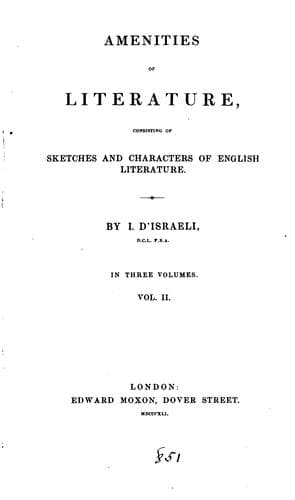
Amenities of Literature: Consisting of Sketches and Characters of English LiteratureDisraeli, Isaac
History
Amenities of Literature: Consisting of Sketches and Characters of English Literature
Disraeli, Isaac
Authors, English -- Biography; English literature -- History and criticism; Great Britain -- Intellectual life
Here the tale is plain, for this is the language of one who early in
life had engaged in some popular scheme, and these early indications of
the temper of the Wickliffite or the Lancastrian, or both, had
subsequently led to some more perilous attempts. They were, like all
reforms, something "noble and glorious for the people," and as sometimes
happens among reformers, what _at first_ appeared to promise so well,
ended in disappointment and "penance in a dark prison."
The locality of this patriotic act was the city of London. He alludes to
"free elections by great clamours of much people," for great disease of
misgovernment in the hands of "_torcentious citizens_." When the fatal
day arrived that he openly joined with a party for "the people," against
those citizens whom he has so awfully denounced, it is evident, though
we have no means to discriminate factions in an age of factions,[2]
that he and his "conjurors" discovered that "all the people" were not of
one mind. This votary or this victim of reform suddenly flings his
contempt at "the hatred of the mighty senators of London or of its
commonalty," and closes with a painful remembrance of "the janglings of
THE SHEEPY PEOPLE!" The style of Chaucer bears the stamp of passionate
emotions; words of dimension, or of poignant sarcasm. The "torcentious
citizens" is an awful bolt, and "the sheepy people" is sufficiently
picturesque.
In dismay the whole party took flight. Chaucer, in Zealand, exhausted
his means to supply the wants of his political associates, till he
himself found that even the partnership of common misery does not always
preserve men from ingratitude. Returning home, potent persecutors cast
him into a dungeon. Was the Duke of Lancaster absent, or the Duke of
Gloucester in power? Let us observe that in all these dark events the
loyalty of the poet is never impeached, for Chaucer enjoyed without
interruption the favour of both his sovereigns, Edward III. and Richard
II.; and we discover that once when dismissed from office, Richard
allowed him to serve by deputy, which was evidence that Chaucer had
never been dismissed by the king himself. The whole transaction,
whatever it was, was a political movement between two factions. Chaucer
indeed pleads that whatever he had done was under the control of others,
himself being but "the servant of his sovereign." At that period the
factions in the state were more potent than the monarch. In the
convulsive administration of a youthful prince, they who oppose the
court are not necessarily opposing the sovereign.
Public-domain text, read in full here on John Shaqi.
Reviews
Reviews
No reviews yet
Be the first to share your thoughts on this work.
Elsewhere in the archive
Join the Discussion
Join the discussion
Sign in to leave a comment or review.
Sign InorCreate an account