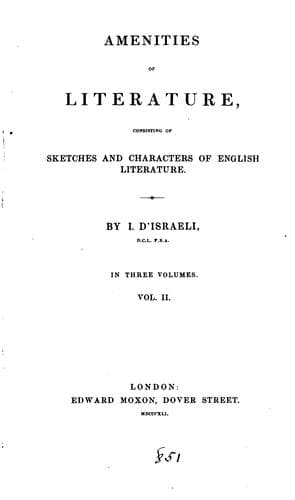
Amenities of Literature: Consisting of Sketches and Characters of English LiteratureDisraeli, Isaac
History
Amenities of Literature: Consisting of Sketches and Characters of English Literature
Disraeli, Isaac
Authors, English -- Biography; English literature -- History and criticism; Great Britain -- Intellectual life
This defective chronology in the life of the poet has involved the more
important subject of the chronology of his works. Posterity may be
little concerned in the dates of his birth and his burial--his unknown
parentage--his descriptive name--and, above all, his suspicious shield,
which the heralds opined must have been blazoned out of the
twenty-seventh and twenty-eighth propositions of the first book of
Euclid, from the poet's love of geometry, or, more obviously, from
having no coat-of-arms to show of "far more ancient antiquity." But
posterity would have been interested in the history of the genius of
Chaucer, who having long paced in a lengthened circuit of verbal version
and servile imitation, passed through some remarkable transitions,
kindling the cold ashes of translation into the fire of invention; from
cloudy allegory breaking forth into the sunshine of the loveliest
landscape-painting; and from the amatory romance gliding into that vein
of humour and satire which in his old age poured forth a new creation.
All this he might himself have told, or Gower might have revealed, had
the elder bard who lauded the lays and "ditties" of the youth of "the
Clerk of Venus" loved him as well in his old age. But elegant
literature, as distinguished from scholastic, was then without price or
reward. The few men of genius who have written at this early period are
only known to us by their writings, and probably were more known to
their contemporaries by the station which they may have occupied, than
by that which they maintain with posterity.
By royal patents and grants to the poet, we trace his early life at
court, his various appointments, and his honourable missions to Genoa
and to France--we must not add as confidently his visit to Petrarch.
Chaucer, in his political life, was bound up with the party of John of
Gaunt, Duke of Lancaster; and, by a congenial spirit, with the novel
doctrines of his friend, Dr. Wickliffe. The sister of his lady finally
became the third Duchess of Lancaster, and the family alliance
strengthened the political bond. How the Lancastrian exploded in the
poet, something we know, but little we comprehend; and those who have
attempted to lift the veil have not congratulated themselves on their
success. The poet himself has not entrusted his secret to posterity,
except, as is usual with poets, by eloquent lamentations. The exposition
of a political transaction is never without some valued results; and
though deprived of names and dates, we are not without some dim lights:
the palpable truth may not be obvious, but it may happen that we may
stumble on it.
Chaucer himself has stated, "In _my youth_ I was drawn in to be
assenting to certain _conjurations_ and other _great matters of ruling
of citizens_, and those things have been my _drawers in and exciters_ in
the matters _so painted and coloured_, that _first_ to me seemed then
_noble and glorious for all the people_."
Public-domain text, read in full here on John Shaqi.
Reviews
Reviews
No reviews yet
Be the first to share your thoughts on this work.
Elsewhere in the archive
Join the Discussion
Join the discussion
Sign in to leave a comment or review.
Sign InorCreate an account