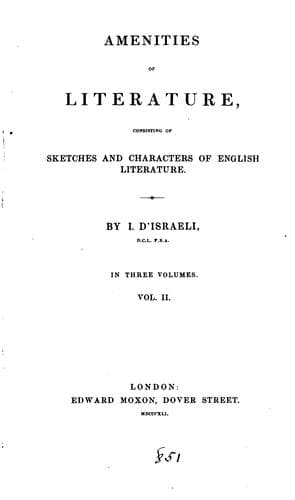
Amenities of Literature: Consisting of Sketches and Characters of English LiteratureDisraeli, Isaac
History
Amenities of Literature: Consisting of Sketches and Characters of English Literature
Disraeli, Isaac
Authors, English -- Biography; English literature -- History and criticism; Great Britain -- Intellectual life
This obscure apology conceals the agony of conflicting
emotions--indignation at ungrateful associates, and a base desertion of
ancient friends, who were plotting against him. Whether Chaucer was
desirous of burying in obscurity a story of torturous details, or one
too involved in confused motives for any man to tell with the precision
of a simple statement, we know of no evidence which can enable us to
decide with any certainty on an affair which no one pretends to
understand. Chaucer might have been the scapegoat of the sovereign, or
the champion of the people. We can rather decide on his calamity than
his conduct. Many are the causes which may dissolve the bonds of
faithless "conjurations;" and it is not always he who abandons a party
who is to be criminated by political tergiversation.
The circumstances of Chaucer's life had combined with his versatile
powers. He had mingled with the world's affairs both at home and abroad:
accomplished in manners, and intimately connected with a splendid court,
Chaucer was at once the philosopher who had surveyed mankind in their
widest sphere, the poet who haunted the solitudes of nature, and the
elegant courtier whose opulent tastes are often discovered in the
graceful pomp of his descriptions. It was no inferior combination of
observation and sympathy which could bring together into one company the
many-coloured conditions and professions of society, delineated with
pictorial force, and dramatised by poetic conception, reflecting
themselves in the tale which seemed most congruous to their humours. The
perfect identity of these assembled characters, after the lapse of near
five centuries, make us familiar with the domestic habits and modes of
thinking of a most interesting period in our country, not inspected by
the narrow details of the antiquarian microscope, but in the broad
mirror reflecting that truth or satire which alone could have
discriminated the passions, the pursuits, and the foibles of society.
Thus the painter of nature, who caught the glow of her skies and her
earth in his landscape, was also the miniature portrayer of human
likenesses. When Chaucer wrote, the classics of antiquity were
imperfectly known in this country--the Grecian muse had never reached
our shores; this was, probably, favourable to the native freedom of
Chaucer. The English poet might have lost his raciness by a cold
imitation of the Latin masters; among the Italians, Dante, Petrarch, and
Boccaccio, Chaucer found only models to emulate or to surpass. Hence the
English bard indulged that more congenial abundance of thoughts and
images which owns no other rule than the pleasure it yields in the
profusion of nature and fancy. A great poet may not be the less Homeric
because he has never read Homer.
Public-domain text, read in full here on John Shaqi.
Reviews
Reviews
No reviews yet
Be the first to share your thoughts on this work.
Elsewhere in the archive
Join the Discussion
Join the discussion
Sign in to leave a comment or review.
Sign InorCreate an account