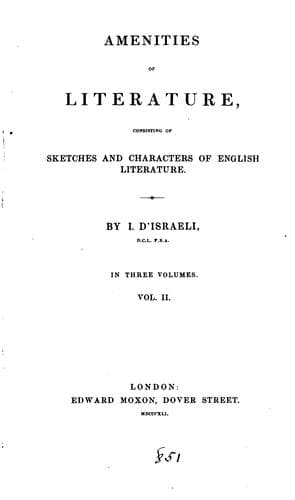
Amenities of Literature: Consisting of Sketches and Characters of English LiteratureDisraeli, Isaac
History
Amenities of Literature: Consisting of Sketches and Characters of English Literature
Disraeli, Isaac
Authors, English -- Biography; English literature -- History and criticism; Great Britain -- Intellectual life
The Herculean labour of CHAUCER was the creation of a new style. In this
he was as fortunate as he was likewise unhappy. He mingled with the
native rudeness of our English words of Provençal fancy, and some of
French and of Latin growth. He banished the superannuated and the
uncouth, and softened the churlish nature of our hard Anglo-Saxon; but
the poet had nearly endangered the novel diction when his artificial
pedantry assumed what he called "the ornate style" in "the Romaunt of
the Rose," and in his "Troilus and Cressida." This "ornate style"
introduced sesquipedalian Latinisms, words of immense dimensions, that
could not hide their vacuity of thought. Chaucer seems deserted by his
genius when "the ornate style" betrays his pangs and his anxiety. As the
error of a fine genius becomes the error of many, because monstrous
protuberances may be copied, while the softened lines of beauty remain
inimitable, this "ornate style" corrupted inferior writers, who, losing
all relish of the natural feeling and graceful simplicity of their
master, filled their verse with noise and nonsense. This vicious style,
a century afterwards, was resumed by STEPHEN HAWES. We have, however, a
glorious evidence, amid this struggle both with a new and with a false
style, of Chaucer's native good taste; he finally wholly abandoned this
artificial diction; and his later productions, no longer disfigured by
such tortured phrases and such remote words, awaken our sympathy in the
familiar language of life and passion.
TYRWHIT has ingeniously constructed a metrical system to arrange the
versification to the ear of a modern reader; by this contrivance he
would have removed all obstructions in the pronunciation and in the
syllabic quantities. He maintained that the lines were regular
decasyllabics. But who can read this poet for any length, even the
"Canterbury Tales" in the elaborated text of Tyrwhit, without being
reminded of its fallacy? Even the E final, on which our critic has laid
such stress, though often sounded, assuredly is sometimes mute. Dan
Chaucer makes at his pleasure words long or short, and dyssyllabic or
trisyllabic; and this he has himself told us--
But for the rime is light and lewde,
Yet make it somewhat agreáble,
Though some verse fail in a sylláble.
Our critic was often puzzled by his own ingenuity, for in some
inveterate cases he has thrown out in despair an observation, that "a
reader who cannot perform such operations for himself (that is, helping
out the metre) had better not trouble his head about the versification
of our ancient authors." The verse of Chaucer seems more carefully
regulated in his later work, "the Tales;" but it is evident that Chaucer
trusted his cadences to his ear, and his verse is therefore usually
rhythmical, and accidentally metrical.
Public-domain text, read in full here on John Shaqi.
Reviews
Reviews
No reviews yet
Be the first to share your thoughts on this work.
Elsewhere in the archive
Join the Discussion
Join the discussion
Sign in to leave a comment or review.
Sign InorCreate an account