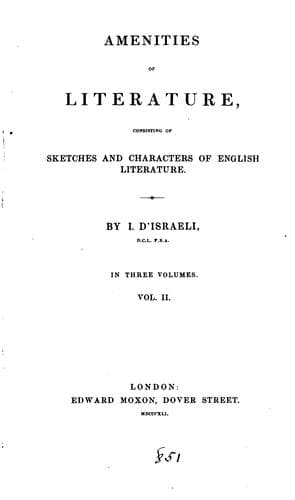
Amenities of Literature: Consisting of Sketches and Characters of English LiteratureDisraeli, Isaac
History
Amenities of Literature: Consisting of Sketches and Characters of English Literature
Disraeli, Isaac
Authors, English -- Biography; English literature -- History and criticism; Great Britain -- Intellectual life
Bade one reach me a Boke,
A ROMANCE, and he it me took
To read, and drive the Night away;
For methought it better play
Than play either at Chess or Tables.
And assuredly Chaucer found many passages in the old fablers not less
entrancing than some of his own. Our poet indulged this vein of playful
irony on persons as well as on things. A sly panegyric, sufficiently
ambiguous for us to accept as a refined stroke, we find on the abstruse
and interminable question of predestination; on which the Nonne's priest
declares--
But I ne cannot boult it to the bren,
As can the holy doctor Augustín,
Or Boecé, or _the bishop Bradwardín_.
As this bishop, afterwards Archbishop of Canterbury, was the first who
treated theology on mathematical principles, and likewise wrote on the
"Quadrature of the Circle," we may presume "Bishop Bradwardin" rather
perplexed the poet. Chaucer discovers his ironical manner when gravely
stating the different theories of dreaming--
---------What causeth Suevenes[3]
On the morrow or on evens?
he playfully concludes, and modern philosophy could no better assist the
inquiry--
---------Whoso of these Miracles
The causes know bet[4] than I
Define he, for I certainly
Ne can them not, ne never thinke
To busie my witte for to swinke
To know why this is more than that is,
Well worthé of this thing Clerkés,
That treaten of this and of other werkés,
For I, of none opinion
Nil.
It is with the same pleasantry he avoids all commonplace descriptions,
by playfully suggesting his pretended unskilfulness for the detail, or
his want of learning--
Me list not of the chaf, ne of the stre,
Maken so long a tale, as of the corn.
"Man of Lawe's Ta'e."
Yet humour and irony are not his only excellences, for those who study
Chaucer know that this great poet has thoughts that dissolve in
tenderness; no one has more skilfully touched the more hidden springs of
the heart.
Public-domain text, read in full here on John Shaqi.
Reviews
Reviews
No reviews yet
Be the first to share your thoughts on this work.
Elsewhere in the archive
Join the Discussion
Join the discussion
Sign in to leave a comment or review.
Sign InorCreate an account