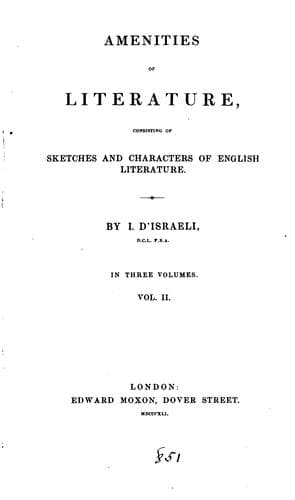
Amenities of Literature: Consisting of Sketches and Characters of English LiteratureDisraeli, Isaac
History
Amenities of Literature: Consisting of Sketches and Characters of English Literature
Disraeli, Isaac
Authors, English -- Biography; English literature -- History and criticism; Great Britain -- Intellectual life
Are the works of our great poet to be consigned to the literary dungeon
of the antiquary's closet? I fear that there is more than one
obstruction which intervenes between the poet's name, which will never
die, and the poet's works, which will never be read. A massive tome,
dark with the Gothic type, whose obsolete words and difficult phrases,
and, for us, uncadenced metre, are to be conned by a glossary as
obsolete as the text, to be perpetually referred to, to the interruption
of all poetry and all patience, appalled even the thorough-paced
antiquary, Samuel Pegge, as appears by his honest confession. Already a
practised bibliosopher proclaims, alluding to the edition by Tyrwhit of
Chaucer's "Canterbury Tales," "And who reads any other portion of the
poet?" Yet the "Canterbury Tales" are but the smallest portion of
Chaucer's works! But some skilful critics have perpended and decided
differently: even among the projected labours of Johnson was an edition
of Chaucer's works; and Godwin, when diligently occupied on this great
poet, with just severity observed that "a vulgar judgment had been
propagated by slothful and indolent persons, that the 'Canterbury Tales'
are the only part of the works of Chaucer worthy the attention of a
modern reader, and this has contributed to the wretched state in which
his works are permitted to exist."
Are we then no longer to linger over the visionary emotions of the great
poet in the fine portraitures of his genius from his youthful days, when
the fever of his soul, not knowing where to seek for its true aliment,
careless of life, fed on its own sad musings, in Chaucer's "DREME," or,
onwards in life, in the "TESTAMENT OF LOVE," that chronicle of the heart
in a prison solitude? And are we no longer interested in those personal
traits Chaucer has so frequently dropped of his own tastes and humours,
so that we are in fact better acquainted with Chaucer than we are with
Shakspeare? Even during his official occupations, this poet loved his
studious solitary nights, and frequently alludes to his passion. Must we
close that "HOUSE OF FAME," with whose fragments Pope reared "The
Temple?" Has all the enchantment of the moonlight-land of chivalry and
fairyism in "THE FLOURE AND THE LEAFE" vanished? Are we no longer to
listen to "THE COMPLAINT OF THE BLACK KNIGHT," which touched a duchess
or a queen? or the stanzas of "THE CUCKOO AND THE NIGHTINGALE," which
musically resound that musical encounter? Is the legend of pathetic
tenderness in the impassioned "TROILUS," and "the sillie woman who
falsed Troilus," ever to be closed? there may we pursue the vicissitudes
of love, in what the poet calls "a little tragedy;" and we find Ovidian
graces amid its utter simplicity. There are, indeed, vicissitudes of
taste as well as of love. "Troilus and Cressida" was the favourite in
the days of Henry VIII. over the "Canterbury Tales" and "The Floure and
the Leafe;" it was, too, the model of Sidney in the court of Elizabeth;
Public-domain text, read in full here on John Shaqi.
Reviews
Reviews
No reviews yet
Be the first to share your thoughts on this work.
Elsewhere in the archive
Join the Discussion
Join the discussion
Sign in to leave a comment or review.
Sign InorCreate an account