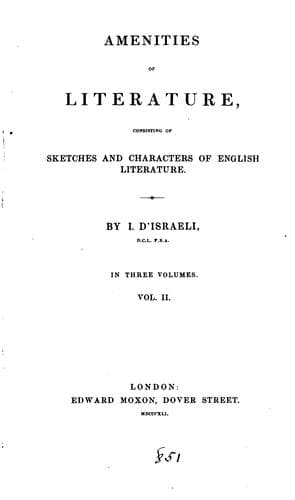
Amenities of Literature: Consisting of Sketches and Characters of English LiteratureDisraeli, Isaac
History
Amenities of Literature: Consisting of Sketches and Characters of English Literature
Disraeli, Isaac
Authors, English -- Biography; English literature -- History and criticism; Great Britain -- Intellectual life
Love triumphed at court over Humour and Fancy.
It is true that the language of Chaucer has failed, but not the writer.
The marble which Chaucer sculptured has betrayed the noble hand of the
artist; the statue was finished; but the grey and spotty veins came
forth, clouding the lucid whiteness.
For the poet or the poetical, the difficulty of the language may be
surmounted with a reasonable portion of every-day patience. I know, from
several of my literary contemporaries, that this, however, has not been
conceded. The more familiar I became with Chaucer, the more I delighted
in the significance of the Chaucerian words. From some modern critics,
occasionally the name of Chaucer startles the ear. One, indeed, has
recently complained that "Chaucer's divine qualities are languidly
acknowledged by his unjust countrymen;"[5] and Coleridge emphatically
said, "I take unceasing delight in Chaucer. His manly cheerfulness is
especially delicious in my old age. How exquisitely tender he is!"[6]
But the popularity of this gifted child of nature, and this shrewd
observer of mankind, is doomed to another obstruction than that of his
curious diction. The playfulness of his comic invention, and the freedom
of his simplicity, will no longer be allowed to atone for the levity of
some of his incidents. When Warton, to display the genuine vein of the
Chaucerian humour, imprudently analysed the "Miller's Tale," having
reached the middle, the critic, recollecting himself, suddenly breaks
off with a curt remark--"The sequel cannot be repeated here!" In a
recklessness of all knowledge, and in an unhappy hour, the poet of "Don
Juan" decided, while he probably would have started from Chaucer's
black-letter tome, that "Chaucer, notwithstanding the praises bestowed
on him, I think obscene and contemptible. He owed his celebrity merely
to his antiquity." As if the greatest of our poets had only been
celebrated in the day when Byron wrote! Yet in all the unfettered
invention and nudity of style, there was no grossness in the temper, and
less in the habits, of the poet. He addressed his own age as his
contemporaries were doing in France and in Italy, and from whom he had
borrowed the very two tales on which this censure has fallen. In telling
"a merrie tale," Chaucer could not have anticipated this charge; and, in
truth, for subjects which are obscene and disgustful he had no taste, as
he showed in his reproof of Gower for having selected two repulsive
ones--the unnatural passions of Canace and Apollonius Tyrius. Of these
our Chaucer cries,--
Of all swiche cursed stories I say, Fy!
Our poet has himself pleaded that having fixed on his personage, he had
no choice to tell any other tale than what that individual would himself
have told. Before we immolate Chaucer on the altar of the Graces, we
should not only listen to his plea, but to his own easy remedy for this
disorder produced by his too faithful copy after nature.
Public-domain text, read in full here on John Shaqi.
Reviews
Reviews
No reviews yet
Be the first to share your thoughts on this work.
Elsewhere in the archive
Join the Discussion
Join the discussion
Sign in to leave a comment or review.
Sign InorCreate an account