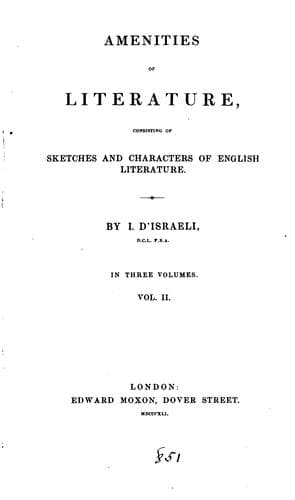
Amenities of Literature: Consisting of Sketches and Characters of English LiteratureDisraeli, Isaac
History
Amenities of Literature: Consisting of Sketches and Characters of English Literature
Disraeli, Isaac
Authors, English -- Biography; English literature -- History and criticism; Great Britain -- Intellectual life
Tom comes, thereat, when called by Wat, and Simon as forward we find;
Bet calls as quick to Gibb, and to Hyck that neither would tarry
behinde.
Gibbe, a good whelp of that litter, doth help mad Coll more mischief
to do,
And Will he doth vow, the time is come now, he'll join with their
company too.
Davie complains whiles Grigg gets the gains, and Hobb with them doth
partake;
Lorkin aloud, in the midst of the crowd, conceiveth as deep is his
stake.
Hudde doth spoil, whom Judde doth foile, and Tebbe lends his helping
hand,
But Jack, the mad-patch, men and horses doth snatch, and kills all at
his command.
The third and greater work, and the only printed one of Gower, is the
"Confessio Amantis," an English poem of about thirty thousand lines; a
singular miscellany of allegory, of morality, and of tales. It is
studded with sententious maxims and proverbs, and richly diversified
with narrations, pleasant and tragic; but the affectation of learning,
for learning in its crude state always obtrudes itself, even in works of
recreation, has compressed the Aristotelian philosophy, to edify and
surprise the readers of the poet's fairy or romantic tales. Robert de
Brunne, to illustrate monachal morals, interspersed domestic stories;
and amidst the prevalent penury of imagination, that rhyming monk
affords the most ancient specimens of English tales in verse: and as
Gower's single printed work is of the same species of composition, a
system of ethics illustrated by tales, it has been thought that the
monk who rhymed in 1300 was the true predecessor of the poet who
flourished at the close of that century, however Gower may have purified
the "rime doggrel," and elevated the puerile tale. The straw-roof must
be raised before the cupola. Genius in its genealogy must not blush at
its remote ancestor; the noblest knight may often go back to the mill or
the forge. If this rude moralising rhymer really be the poetical father
of Gower, then is this antiquated monk the inventor of that narrative
poetry which Chaucer, Spenser, Dryden, and even some of our
contemporaries, have so delightfully diversified. But story-telling has
been of all periods.
There is a portion in this volume which concerns the personal history of
the poet.
Public-domain text, read in full here on John Shaqi.
Reviews
Reviews
No reviews yet
Be the first to share your thoughts on this work.
Elsewhere in the archive
Join the Discussion
Join the discussion
Sign in to leave a comment or review.
Sign InorCreate an account