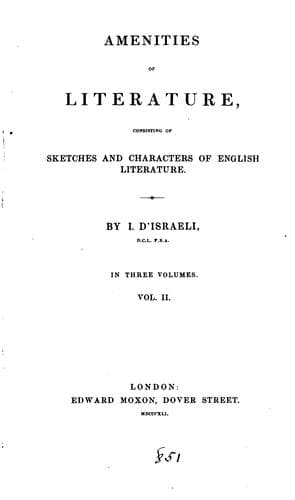
Amenities of Literature: Consisting of Sketches and Characters of English LiteratureDisraeli, Isaac
History
Amenities of Literature: Consisting of Sketches and Characters of English Literature
Disraeli, Isaac
Authors, English -- Biography; English literature -- History and criticism; Great Britain -- Intellectual life
[8] This "sagacity" has been much and justly questioned by the more
advanced students of medieval literature. Sir Harris Nicolas has
produced an excellent edition of the poet; but the best text of the
"Canterbury Tales" has been published by Mr. Thos. Wright, from a
careful collation of the oldest manuscript.--ED.
GOWER.
In the church of St. Saviour in Southwark may be viewed an ancient
monument with its sculptured and Gothic canopy; pictured on its side the
three visionary virgins, Charity, Mercy, and Pity, solicit the prayer of
the passenger for the soul of the suppliant whose image lies extended on
the tomb, with folded hands, and in his damask habit flowing to his
feet. His head reposes on three mighty tomes, and is decked with a
garland, either of roses which proclaim his knighthood, or the wreath of
literature which would more justly distinguish the wearer,--JOHN GOWER,
the poet.
In the life of this poet, almost the only certain incident seems to be
his sepulchral monument: and even this it had been necessary to repair
after the malignity of the Iconoclasts; and of the three sculptured
volumes which support the poet's head, a single one only has been opened
by the world, for the tomb has perpetuated what the press has not.
The three tomes on the tomb of Gower represent his three great works;
but what is remarkable, and shows the unsettled state of our literature,
each of these great works is written in a different language, though
equally graced with Latin titles. The first, in French, is the "Speculum
Meditantis;" the moral reflections relieved by historical examples. The
second, in Latin verse, is "Vox Clamantis;" this "Voice" comes not from
the desert, for it is that of the clamours of the people; a satire on
all ranks, and an exhortation to the youthful monarch to check his own
self-indulgence; it includes a chronicle of the insurrection of the
populace, or "the clowns," as they were called in Richard the Second's
reign. The vernacular style, rather than Latin verse, would have more
aptly celebrated the feats of Wat Tyler, or Bet and Sim, Gibbe and Hyke,
Hudde and Judde, Jack and Tib. The reporter had no doubt been present at
the active scene. The swarm rush on to the call of one another, in
hexameters and pentameters. The singularity of the subject, which gives
no bad picture of the hurry of a disorderly mob, and the felicity of an
old translation, induce me to preserve a partial extract from the
manuscript. Our own age has witnessed similar scenes.
Watte vocat, cui Thome venit, neque Symme retardat,
Betteque, Gibbe simul Hyke venire jubent.
Colle furit, quem Gibbe juvat nocumenta parantes,
Cum quibus ad dampnum Wille coire vovet.
Grigge rapit, dam Dawe strepit, comes est quibus Hobbe,
Lorkin et in medio non minor esse putat.
Hudde ferit, quos Judde terit, dum Tebbe juvatur,
Jacke domos que viros vellit, et ense necat.
Public-domain text, read in full here on John Shaqi.
Reviews
Reviews
No reviews yet
Be the first to share your thoughts on this work.
Elsewhere in the archive
Join the Discussion
Join the discussion
Sign in to leave a comment or review.
Sign InorCreate an account