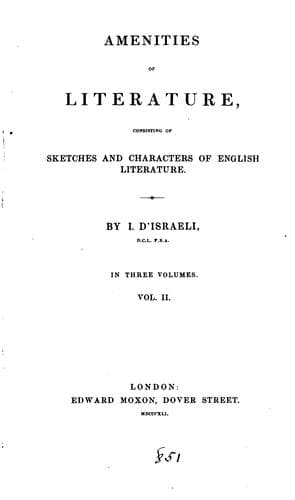
Amenities of Literature: Consisting of Sketches and Characters of English LiteratureDisraeli, Isaac
History
Amenities of Literature: Consisting of Sketches and Characters of English Literature
Disraeli, Isaac
Authors, English -- Biography; English literature -- History and criticism; Great Britain -- Intellectual life
In the course of the reign of Richard the Second it appears that several
alterations were made in the poem. The dedicatory preface was
suppressed. Berthelet, the ancient printer of the "Confessio Amantis,"
discovered that "the prologue" had disappeared, though the same number
of lines were substituted, "cleane contrary both in sentence and in
meaning." Gower has therefore incurred the reproach of a disloyal
desertion of his hapless master to court a successful usurper. One
critic tells that "he was given to change with the turns of state."
Bishop Nicholson, with dull levity, has a fling at all poets, for he
censures Gower for "making too free with his prince--a liberty, it
seems, allowed to men of his profession;" while Thomas Hearne, the blind
bigot of passive obedience, in editing a monkish life of Richard the
Second, would have all Gower condemned to oblivion, because "he had
treated the monarch's memory ill, and spoke with equal freedom of the
clergy." This vacillating conduct of "the moral Gower," however, need
not leave any stain on his memory. We see he had never at any time
adulated the youthful monarch; however his tales may have charmed the
royal ear, the verse often left behind a wholesome bitterness. Gower had
praised Henry of Lancaster at a period when he could not have
contemplated the change of dynasty; and when it happened, the poet was
of an age far too advanced either to partake of the hopes or the fears
that wait on a new reign.
But this tale of Gower's free and honest satire on courts and courtiers
is not yet concluded. The sphere of a poet's influence is far wider than
that of his own age; and however we may now deem of this grave and
ancient poet, he still found understanding admirers so late as in the
reign of Charles the First. In the curious "Conference" which took place
when Charles the First visited the Marquess of Worcester, at Ragland
Castle, with his court, there is the following anecdote respecting the
poet Gower.
The marquess was a shrewd though whimsical man, and a favourite of the
king for his frankness and his love of the arts. His lordship
entertained the royal guest with extraordinary magnificence. Among his
rare curiosities was a sumptuous copy of Gower's volume.
Charles the First usually visited the marquess after dinner. Once he
found his lordship with the book of John Gower lying open, which the
king said he had never before seen. "Oh!" exclaimed the marquess; "it is
a book of books! and if your majesty had been well versed in it, it
would have made you a king of kings." "Why so, my lord?" "Why, here is
set down how Aristotle brought up and instructed Alexander the Great in
all the rudiments and principles belonging to a prince." And under the
persons of Aristotle and Alexander, the marquess read the king such a
lesson that all the standers-by were amazed at his boldness.
Public-domain text, read in full here on John Shaqi.
Reviews
Reviews
No reviews yet
Be the first to share your thoughts on this work.
Elsewhere in the archive
Join the Discussion
Join the discussion
Sign in to leave a comment or review.
Sign InorCreate an account