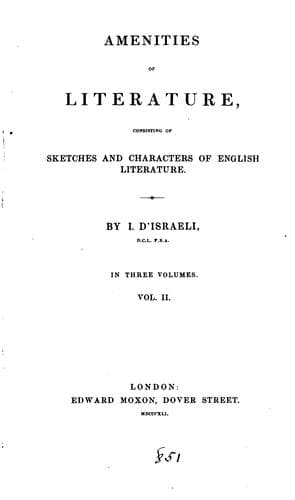
Amenities of Literature: Consisting of Sketches and Characters of English LiteratureDisraeli, Isaac
History
Amenities of Literature: Consisting of Sketches and Characters of English Literature
Disraeli, Isaac
Authors, English -- Biography; English literature -- History and criticism; Great Britain -- Intellectual life
The king asked whether he had his lesson by heart, or spake out of the
book? "Sir, if you would read my heart, it may be that you might find it
there; or if your majesty pleased to get it by heart, I will lend you my
book." The king accepted the offer.
Some of the new-made lords fretted and bit their thumbs at certain
passages in the marquess's discourse; and some protested that no man was
so much for the absolute power of a king as Aristotle. The marquess told
the king that he would indeed show him one remarkable passage to that
purpose; and turning to the place, read--
A king can kill, a king can save;
A king can make a lord a knave;
And of a knave, a lord also.
On this several new-made lords slank out of the room, which the king
observing, told the marquess, "My lord, at this rate you will drive away
all my nobility."
This amusing anecdote is an evidence that this ethical poet, after two
centuries and a half, was not forgotten; his spirit was still vital, his
volume still lay open on the library table; it afforded a pungent lesson
to the courtiers of Charles the First as it had to those of Richard the
Second.
GOWER was learned, didactic, and dignified. The manuscripts of his works
are usually noble and sumptuous copies; more elegantly written and more
richly illuminated than the works of other poets. His commonplaces and
his legendary lore seem to have awed the simplicity of the readers of
two centuries, whose taste did not yet feel that failure of the poet who
narrated a fable from Ovid with the dull prolixity of a matter-of-fact
chronicler. His fictions are rarely imaginative; yet critics, far abler
judges of his relative merits than ourselves, since they lived within
the sphere of his influence, hailed this grave father of our poesy.
Leland, the royal antiquary of Henry the Eighth, expressed his ideas
with great elegance and sensibility, when he said of Gower that "his
diligent culture of our poesy had extirpated the ordinary herbs; and
that the soft violet and the purple narcissus were now growing, where
erst was nothing seen but the thistle and the thorn." There are indeed
some graceful flowers in his desert. But all criticism is usually
relative to the age, and excellence is always comparative. GOWER stamped
with the force of ethical reasoning his smooth rhymes; and this was a
near approach to poetry itself. If in the mind of CHAUCER we are more
sensible of the impulses of genius--those creative and fugitive
touches--his diction is more mixed and unsettled than the tranquil
elegance of GOWER, who has often many pointed sentences and a surprising
neatness of phrase. A modern reader, I think, would find the style of
Gower more easily intelligible than the higher efforts of the more
inventive poet.
PIERS PLOUGHMAN.
Public-domain text, read in full here on John Shaqi.
Reviews
Reviews
No reviews yet
Be the first to share your thoughts on this work.
Elsewhere in the archive
Join the Discussion
Join the discussion
Sign in to leave a comment or review.
Sign InorCreate an account