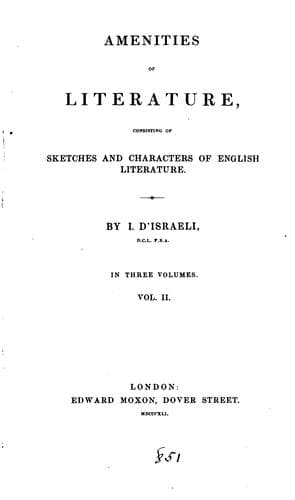
Amenities of Literature: Consisting of Sketches and Characters of English LiteratureDisraeli, Isaac
History
Amenities of Literature: Consisting of Sketches and Characters of English Literature
Disraeli, Isaac
Authors, English -- Biography; English literature -- History and criticism; Great Britain -- Intellectual life
It is useless to give the skeleton of a desultory and tedious
allegorical narrative. The last editor, Dr. Whitaker, imagined that "he
for the first time had shown that it was written after a regular and
consistent design," notwithstanding that he himself confesses, that "the
conclusion is singularly cold and comfortless and _leaves the inquirer,
after a long peregrination, still remote from the object of his
search_"--a conclusion where nothing is concluded! The visionist might
have been overtaken by sleep among the bushes of the Malvern Hills for
twenty cantos more, without at all deranging anything which he had said,
or inconveniencing anything which he might say. In truth, it is a heap
of rhapsodies, without any artifice of connexion or involution of plot,
or any sustained interest of one actor more than another among the
numerous ideal beings who flit along the dreamy scenes.
The true spirit of this imaginative work is more comprehensible than any
settled design. That mysterious or mythical personage, "Piers
Ploughman," is the representative of "the Universal Church," says Dr.
Whitaker; or "Christian life," says Mr. Campbell. What he may be is very
doubtful, for we have "True Religion," a fair lady, who puts in surely a
higher claim to represent "the Universal Church," or "Christian life,"
than "the Ploughman," who has to till his half-acre and save his idling
companions from "waste" and "wane." The most important personage is
"Mede," or bribery, who seems to exert an extraordinary influence over
the Bench, and the Bar, and the Church, and through every profession
which occurred to the poet.
The pearls in these waters lie not on the surface. The visionist had
deeper thoughts and more concealed feelings than these rhapsodical
phantoms. In a general survey of society, he contemplates on the court
and the clergy, glancing through all the diversified ranks of the laity,
not sparing the people themselves, as their awful reprover. It was a
voice from the wilderness in the language of the people. The children of
want and oppression had found their solitary advocate. The prelacy,
dissolved in the luxuriousness of papal pomp, and a barbarous
aristocracy, with their rapacious dependents, were mindless of the
morals or the happiness of those human herds, whose heads were counted,
but whose hearts they could never call their own.
We are curious to learn, in this disordered state of the Commonwealth,
the political opinions entertained by this sage. They are as mysterious
as Piers Ploughman himself.
Public-domain text, read in full here on John Shaqi.
Reviews
Reviews
No reviews yet
Be the first to share your thoughts on this work.
Elsewhere in the archive
Join the Discussion
Join the discussion
Sign in to leave a comment or review.
Sign InorCreate an account