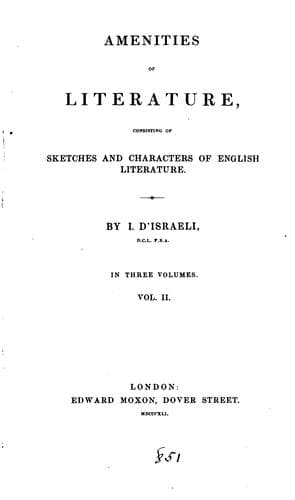
Amenities of Literature: Consisting of Sketches and Characters of English LiteratureDisraeli, Isaac
History
Amenities of Literature: Consisting of Sketches and Characters of English Literature
Disraeli, Isaac
Authors, English -- Biography; English literature -- History and criticism; Great Britain -- Intellectual life
Contemporary with GOWER and CHAUCER lived the singular author of "The
Visions of William concerning PIERS PLOUGHMAN;" singular in more
respects than one, for his subject, his style, and, we may add, for the
intrepidity and the force of his genius.
This extraordinary work is ascribed to one whose name is merely
traditional, to Robert Langland, a secular priest of Salop; when he
wrote, and where he died, are as dubious as his text, the authenticity
of which is often uncertain from the variations in all the manuscripts.
But the real life of an author, at least for posterity, lies beyond the
grave; and no writer is nameless whose volume has descended to us as one
of the most memorable in our ancient vernacular literature.
In character, in execution, and in design, "The Visions of William of
PIERS PLOUGHMAN" are wholly separated from the polished poems of GOWER
and CHAUCER; the work bears no trace of their manner, nor of their
refinement, nor of their versification; and it has baffled conjectural
criticism to assign the exact period of a composition which appears more
ancient than any supposed contemporary writings. Those who would decide
of the time in which an author wrote by his style, here are at a loss to
conceive that the splendid era of romantic chivalry, the age of Edward
the Third and his grandson, which produced the curious learning and the
easy rhymes of the "Confessio Amantis," and the pleasantry and the fine
discriminations of character of the "Canterbury Tales," could have given
birth to the antiquated Saxon and rustic pith of this genuine English
bard. Either his labour was concluded ere the writings of the court
poets had travelled to our obscure country priest in his seclusion in a
distant county, or else he disdained their exotic fancies, their
Latinisms, their Gallicisms, and their Italianisms, and their trivial
rhymes, that in every respect he might remain their astonishing
contrast, with no inferiority of genius. There was no philosophical
criticism in the censure of this poet by Warton, when he condemns him
for not having "availed himself of the rising and rapid improvements of
the English language," and censures him for his "affectation of obsolete
English." These rising improvements may never have reached our bard, or
if they had he might have disdained them; for the writer of the "Visions
concerning Piers Ploughman" was strictly a national poet; and there was
no "affectation of obsolete English" in a poet preserving the forms of
his native idiom, and avoiding all exotic novelties in the energy of his
Anglo-Saxon genius. His uncontaminated mind returned to or continued the
Anglo-Saxon alliterative metre and unrhymed verse; he trusted its
cadence to the ear, scorning the subjection of rhyme. WEBBE, a critic of
the age of Elizabeth, considered this poet as "the first who had
observed the quantity of our verse without the curiosity of rhyme."
Public-domain text, read in full here on John Shaqi.
Reviews
Reviews
No reviews yet
Be the first to share your thoughts on this work.
Elsewhere in the archive
Join the Discussion
Join the discussion
Sign in to leave a comment or review.
Sign InorCreate an account