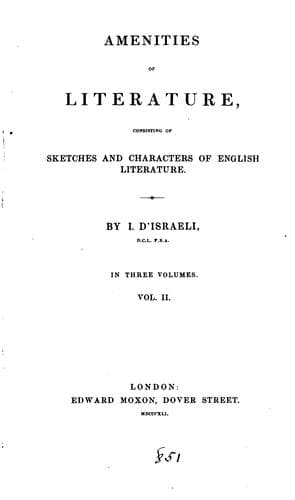
Amenities of Literature: Consisting of Sketches and Characters of English LiteratureDisraeli, Isaac
History
Amenities of Literature: Consisting of Sketches and Characters of English Literature
Disraeli, Isaac
Authors, English -- Biography; English literature -- History and criticism; Great Britain -- Intellectual life
Without, however, depreciating the sagacity of the predictor, there is
reason to suspect that the same thought was occurring to some of the
great themselves. The Reformation of Henry the Eighth may be dated from
the reign of Richard the Second. That mighty transition into a new order
of events in our history would then have occurred, for the stag was
started, and the hunt was up. It was an accidental and unexpected
circumstance which turned aside the impending event, which was to be
future and not immediate. Henry Bolingbroke, in the early part of his
life, seems to have entertained some free opinions respecting the
property of the church. He seemed not unfavourable to Wickliffe's
doctrines, and, when Earl of Derby, once declared that "princes had too
little, and religious houses too much." This unguarded expression, which
was not to be forgotten, we are told, occasioned one of the rebellions
during his reign. But when Henry Bolingbroke usurped the throne, age and
prudence might have come together; the monarch balanced the dread of a
turbulent aristocracy, and the uncertain tenure of dominion to be held
at their pleasure, against the security of sheltering the throne under
the broad alliance of a potent prelacy; a potent prelacy whose doom was
fixed, though the hour had not yet struck! The monarch affixed a bloody
seal to this political convention by granting a statute which made the
offence of heresy capital; a crime which heretofore in law was as
unknown as it seemed impossible to designate, and described only in
figurative terms, as something very alarming, but which any prudent
heretic might easily, if not explain, at least recant. To give it more
solemnity, the statute is delivered in Latin, and the punishment of
burning was to be inflicted "_corum populo, in eminente loco_."[1]
The "Visions of Piers Ploughman," when the day which his prescience
anticipated arrived, were eagerly received; it is said the work passed
through three editions in one year, about 1550, in the reign of the
youthful monarch of the Reformation; the readers at that early period of
printing would find many passages congenial to the popular sentiments,
and our nameless author was placed among the founders of a new era.
Public-domain text, read in full here on John Shaqi.
Reviews
Reviews
No reviews yet
Be the first to share your thoughts on this work.
Elsewhere in the archive
Join the Discussion
Join the discussion
Sign in to leave a comment or review.
Sign InorCreate an account