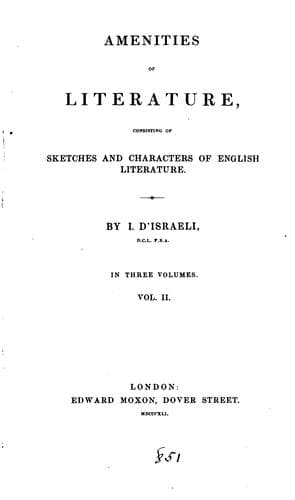
Amenities of Literature: Consisting of Sketches and Characters of English LiteratureDisraeli, Isaac
History
Amenities of Literature: Consisting of Sketches and Characters of English Literature
Disraeli, Isaac
Authors, English -- Biography; English literature -- History and criticism; Great Britain -- Intellectual life
The "VISIONS OF PIERS PLOUGHMAN" will always offer studies for the
poetical artist. This volume, and not Gower's nor Chaucer's, is a well
of English undefiled. SPENSER often beheld these Visions; MILTON, in his
sublime description of the Lazar House, was surely inspired by a
reminiscence of Piers Ploughman. Even Dryden, whom we should not suspect
to be much addicted to black-letter reading beyond his Chaucer, must
have carefully conned our Piers Ploughman; for he has borrowed one very
striking line from our poet, and possibly may have taken others. BYRON,
though he has thrown out a crude opinion of Chaucer, has declared that
"the Ploughman" excels our ancient poets. And I am inclined to think
that we owe to Piers Ploughman an allegorical work of the same wild
invention, from that other creative mind, the author of the "Pilgrim's
Progress." How can we think of the one, without being reminded of the
other? Some distant relationship seems to exist between the Ploughman's
_Dowell_ and _Dobet_, and _Dobest_, Friar _Flatterer_, _Grace_ the
Portress of the magnificent Tower of _Truth_ viewed at a distance, and
by its side the dungeon of _Care_, _Natural Understanding_, and his lean
and stern wife _Study_, and all the rest of this numerous company, and
the shadowy pilgrimage of the "Immortal Dreamer" to "the Celestial
City." Yet I would mistrust my own feeling, when so many able critics,
in their various researches after a prototype of that singular
production, have hitherto not suggested what seems to me obvious.[2]
Why our rustic bard selected the character of a ploughman as the
personage adapted to convey to us his theological mysteries, we know not
precisely to ascertain; but it probably occurred as a companion fitted
to the humbler condition of the apostles themselves. Such, however, was
the power of the genius of this writer, that his successors were content
to look for no one of a higher class to personify their solemn themes.
Hence we have "The Crede of Piers Ploughman;" "The Prayer and Complaint
of the Ploughman;" "The Ploughman's Tale," inserted in Chaucer's volume;
all being equally directed against the vicious clergy of the day.
"The Crede of Piers Ploughman," if not written by the author of the
"Vision," is at least written by a scholar who fully emulates his
master; and Pope was so deeply struck with this little poem, that he has
very carefully analysed the whole.
FOOTNOTES:
[1] Barrington's "Observations on the more ancient Statutes."
Public-domain text, read in full here on John Shaqi.
Reviews
Reviews
No reviews yet
Be the first to share your thoughts on this work.
Elsewhere in the archive
Join the Discussion
Join the discussion
Sign in to leave a comment or review.
Sign InorCreate an account