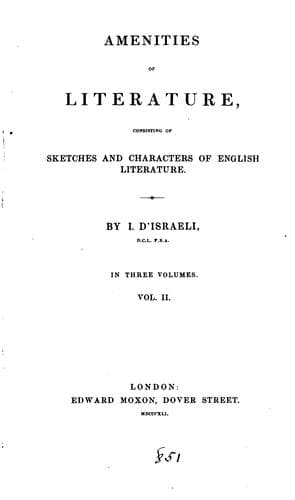
Amenities of Literature: Consisting of Sketches and Characters of English LiteratureDisraeli, Isaac
History
Amenities of Literature: Consisting of Sketches and Characters of English Literature
Disraeli, Isaac
Authors, English -- Biography; English literature -- History and criticism; Great Britain -- Intellectual life
[2] For the general reader I fear that "The Visions of Piers
Ploughman" must remain a sealed book. The last edition of Dr.
WHITAKER, the most magnificent and frightful volume that was ever
beheld in the black letter, was edited by one whose delicacy of taste
unfitted him for this homely task: the plain freedom of the vigorous
language is sometimes castrated, with a faulty paraphrase and a
slender glossary; and passages are slurred over with an annihilating
&c. Much was expected from this splendid edition; the subscription
price was quadrupled, and on its publication every one would rid
himself of the mutilated author. The editor has not assisted the
reader through his barbarous text interspersed with Saxon characters
and abbreviations, and the difficulties of an obscure and elliptical
phraseology in a very antiquated language. Should ever a new edition
appear, the perusal would be facilitated by printing with the white
letter. There is an excellent specimen for an improved text and
edition in "Gent. Mag.," April, 1834. [This improved text of the
"Vision" and "Crede" has, since this note was originally written,
been published with notes by T. Wright, M.A.; and has been again
reprinted recently.]
OCCLEVE; THE SCHOLAR OF CHAUCER.
Warton passed sentence on OCCLEVE as "a cold genius, and a feeble
writer." A literary antiquary, from a manuscript in his possession,
published six poems of Occleve; but that selection was limited to the
sole purpose of furnishing the personal history of the author.[1]
Ritson's sharp snarl pronounced that they were of "peculiar stupidity;"
George Ellis refused to give "a specimen;" and Mr. Hallam, with his
recollection of the critical brotherhood, has decreed, that "the poetry
of Occleve is wretchedly bad, abounding with pedantry, and destitute of
grace or spirit." We could hardly expect to have heard any more of this
doomed victim--this ancient man, born in the fourteenth century,
standing before us, whose dry bones will ill bear all this shaking and
cuffing.
A literary historian, who has read manuscripts with the eagerness which
others do the last novelty, more careful than Warton, and more
discriminate than Ritson, has, with honest intrepidity, confessed that
"OCCLEVE has not had his just share of reputation. His writings greatly
assisted the growth of the popularity of our infant poetry."[2] Our
historian has furnished from the manuscripts of OCCLEVE testimonies of
his assertion.
Among the six poems printed, one of considerable length exhibits the
habits of a dissipated young gentleman in the fourteenth century.
OCCLEVE for more than twenty years was a writer in the Privy Seal, where
we find quarter days were most irregular; and though briberies
constantly flowed in, yet the golden shower passed over the heads of
the clerks, dropping nothing into the hands of these innocents.
Public-domain text, read in full here on John Shaqi.
Reviews
Reviews
No reviews yet
Be the first to share your thoughts on this work.
Elsewhere in the archive
Join the Discussion
Join the discussion
Sign in to leave a comment or review.
Sign InorCreate an account