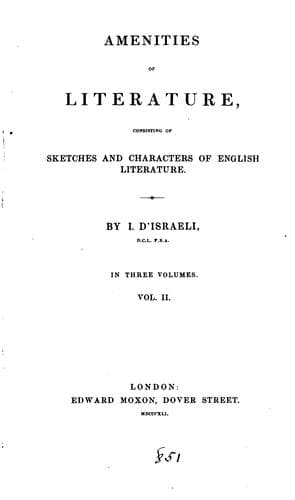
Amenities of Literature: Consisting of Sketches and Characters of English LiteratureDisraeli, Isaac
History
Amenities of Literature: Consisting of Sketches and Characters of English Literature
Disraeli, Isaac
Authors, English -- Biography; English literature -- History and criticism; Great Britain -- Intellectual life
Caxton did not extend his views beyond those of a mercantile printer and
an indifferent translator. As a writer, Caxton had reason to speak with
humility of the style of his vernacular versions. His patroness, the
Lady Margaret, sister to our Edward the Fourth, and Duchess of
Burgundy, after inspecting some quires of his translation of the
"Recuyel of the Historyes of Troye," returned them, finding, as Caxton
ingenuously acknowledges, "some defaut in his English which she
commanded him to amend." Tyrwhit sarcastically observes, that the
duchess might have been a purist. As we are not told what were these
"defauts," we cannot decide on the good taste or the fastidiousness of
the sister of Edward the Fourth. But the duchess was not the only critic
whom Caxton had to encounter, for we learn by his preface to his "Boke
of Æneydos compiled by Virgil," now metamorphosed into a barbarous
French prose romance, and the French translation translated, that there
were "gentlemen who of late have blamed me that in my translations I had
over-curious terms which could not be understood by common people. I
fain would satisfy every man." He apologises for his own style by
alleging the unsettled state of the English language, of which he tells
us that "the language now used varieth far from that which was used and
spoken when I was born." An absence of thirty years from his native land
did not improve a diction which originally had been none of the purest.
We find in his translations an abundance of pure French words, and it is
remarkable that the printer of the third edition of the Troy history, in
1607, altered whole sentences "into plainer English," alleging, "the
translator, William Caxton, being, _as it seemeth_, no Englishman!"
The "curious" prices now given among the connoisseurs of our earliest
typography for their "Caxtons," as his Gothic works are thus honourably
distinguished, have induced some, conforming to traditional prejudice,
to appreciate by the same fanciful value "the Caxtonian style." But
though we are not acquainted with the "defauts" which offended the Lady
Margaret, nor with the "terms which were not easily understood," as
alleged by "the gentlemen," nor with "the sentences improperly
Englished," as the later printer declared, we shall not, I suspect, fall
short of the mark if we conclude that the style of a writer destitute of
a literary education, a prolix genius with a lax verbosity, and almost a
foreigner in his native idiom, could not attain to any skill or felicity
in the maternal tongue.
Public-domain text, read in full here on John Shaqi.
Reviews
Reviews
No reviews yet
Be the first to share your thoughts on this work.
Elsewhere in the archive
Join the Discussion
Join the discussion
Sign in to leave a comment or review.
Sign InorCreate an account