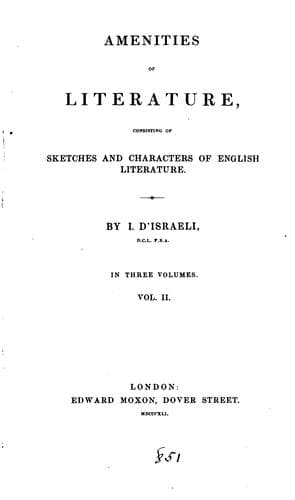
Amenities of Literature: Consisting of Sketches and Characters of English LiteratureDisraeli, Isaac
History
Amenities of Literature: Consisting of Sketches and Characters of English Literature
Disraeli, Isaac
Authors, English -- Biography; English literature -- History and criticism; Great Britain -- Intellectual life
As a printer, without erudition, Caxton would naturally accommodate
himself to the tastes of his age, and it was therefore a consequence
that no great author appears among "the Caxtons." The most glorious
issues of his press were a Chaucer and a Gower, wherein he was simply a
printer. The rest of his works are translations of fabulous histories,
and those spurious writings of the monkish ages ascribed by ignorant
transcribers to some ancient sage. He appears frequently to have been at
a loss what book to print, and to have accidentally chosen the work in
hand; so he tells us--"Having no work in hand, I sitting in my study,
where as lay many diverse paunflettes and bookys, happened that to my
hand came a lytel boke in French, which late was translated out of Latin
by some noble clerk of France, which book is named Æneydos." And this
was the origin of his puerile romance! He exercised no discrimination in
his selection of authors, and the simplicity of our first printer far
exceeded his learning. One of his greater works is "The noble History of
King Arthur and of certain of his Knights." Caxton, who had charmed
himself and his ignorant readers with his authentic "Æneydos," hesitated
to print "this history," for there were different opinions that "there
was no such Arthur, and that all such books as be made of him be but
feigned and fables." It would be difficult to account for the scepticism
of one who always found the marvellous more delectable than the natural,
and who had published so many "feigned" histories--as "The veray trew
History of the valiant Knight Jason," or the "Life of Hercules," and all
"The Merveilles of Virgil's Necromancy," solemnly vouching for their
verity! His sudden scruples were, however, relieved, when "a gentleman"
assured our printer that "it was great folly and blindness in the
disbelievers of this true history."
In the early stage of civilization men want knowledge to feel any
curiosity; like children, they are only affected through the medium of
their imagination. But it is a phenomenon in the history of the human
mind, that at a period of refinement we may approximate to one of
barbarism. This happens when the ruling passion wholly returns to
fiction, and thus terminates in a reckless disregard for all other
studies. Whenever history, severe and lofty, displaying men as they are,
is degraded among the revels and the masques of romance; and the slow
inductions of reasoning, and the minute discoveries of research, and the
nice affinities of analogy, are impatiently rejected, while fiction in
her exaggerated style swells every object into a colossal size, and
raises every passion into hyperbolical violence; a distaste for
knowledge, and a coldness for truth, which must follow, are fatal to the
sanity of the intellect. And thus in the day of our refinement we may be
reverting to our barbarous infancy.
Public-domain text, read in full here on John Shaqi.
Reviews
Reviews
No reviews yet
Be the first to share your thoughts on this work.
Elsewhere in the archive
Join the Discussion
Join the discussion
Sign in to leave a comment or review.
Sign InorCreate an account