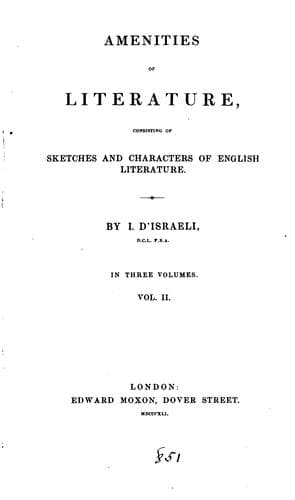
Amenities of Literature: Consisting of Sketches and Characters of English LiteratureDisraeli, Isaac
History
Amenities of Literature: Consisting of Sketches and Characters of English Literature
Disraeli, Isaac
Authors, English -- Biography; English literature -- History and criticism; Great Britain -- Intellectual life
The private libraries of the fifteenth century were restricted to some
French tomes of chivalry, or to "a merrie tale in Boccace;" and their
science advanced not beyond "The Shepherd's Calendar," or "The Secrets
of Albert the Great." There was an intermixture of legendary lives of
saints, and apocryphal adventures of "Notre Seigneur" in Egypt; with a
volume or two of physic and surgery and astrology.
A few catalogues of our monastic libraries still remain, and these
reflect an image of the studies of the middle ages. We find versions of
the Scriptures in English and Latin--a Greek or Hebrew manuscript is not
noted down; a commentator, a father, and some schoolmen; and a writer on
the canon law, and the mediæval Christian poets who composed in Latin
verse. A romance, an accidental classic, a chronicle and legends--such
are the usual contents of these monastic catalogues. But though the
subjects seem various, the number of volumes were exceedingly few. Some
monasteries had not more than twenty books. In such little esteem were
any writings in the vernacular idiom held, that the library of
Glastonbury Abbey, probably the most extensive in England, in 1248,
possessed no more than four books in English,[7] on religious topics;
and in the later days of Henry the Eighth, when Leland rummaged the
monasteries, he did not find a greater number. The library of the
monastery of Bretton, which, owing to its isolated site, was among the
last dissolved, and which may have enlarged its stores with the spoils
of other collections which the times offered, when it was dissolved in
1558, could only boast of having possessed one hundred and fifty
distinct works.[8]
In this primitive state of book-collecting, a singular evidence of their
bibliographical passion was sometimes apparent in the monastic
libraries. Not deeming a written catalogue, which might not often be
opened, sufficiently attractive to remind them of their lettered stores,
they inscribed verses on their windows to indicate the books they
possessed, and over these inscriptions they placed the portraits of the
authors. Thus they could not look through their windows without being
reminded of their volumes; and the very portraits of authors,
illuminated by the light of heaven, might rouse the curiosity which
many a barren title would repel.[9]
To us accustomed to reckon libraries by thousands, these scanty
catalogues will appear a sad contraction of human knowledge. The
monastic studies could not in any degree have advanced the national
character; they could only have kept it stationary; and, excepting some
scholastic logomachies, in which the people could have no concern, one
monkish writer could hardly ever have differed from another.
Public-domain text, read in full here on John Shaqi.
Reviews
Reviews
No reviews yet
Be the first to share your thoughts on this work.
Elsewhere in the archive
Join the Discussion
Join the discussion
Sign in to leave a comment or review.
Sign InorCreate an account