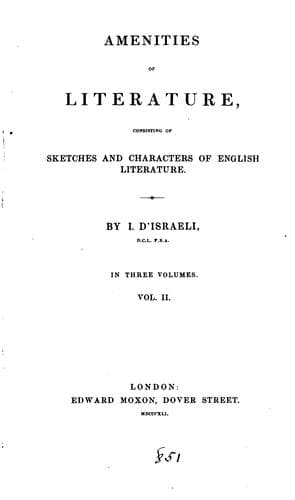
Amenities of Literature: Consisting of Sketches and Characters of English LiteratureDisraeli, Isaac
History
Amenities of Literature: Consisting of Sketches and Characters of English Literature
Disraeli, Isaac
Authors, English -- Biography; English literature -- History and criticism; Great Britain -- Intellectual life
The monastic libraries have been declared to have afforded the last
asylums of literature in a barbarous era; and the preservation of
ancient literature has been ascribed to the monks: but we must not
accept a fortuitous occurrence as any evidence of their solicitude or
their taste. In the dull scriptorium of the monk, if the ancient authors
always obtained so secure a place, they slept in comparative safety, for
they were not often disturbed by their first Gothic owners, who hardly
ever allude to them. If ancient literature found a refuge in the
monastic establishments, the polytheistical guests were not slightly
contemned by their hosts, who cherished with a different taste a
bastardised race of the Romans. The purer writers were not in request;
for the later Latin verse-makers being Christians, the piety of the
monks proved to be infinitely superior to their taste. Boethius was
their great classic; while Prudentius, Sedulius, and Fortunius, carried
the votes against Virgil, Horace, and even Ovid; though Ovid was in some
favour for his marvellous Romance. The polytheism of the classical poets
was looked on with horror, so literally did they construe the
allegorical fables of the Latin muse. Even till a later day, when
monkery itself was abolished, the same Gothic taste lingered among us in
its aversion to the classical poets of antiquity, as the works of
idolaters!
Had we not obtained our knowledge of the great ancients by other
circumstances than by their accidental preservation by the monks, we
should have lost a whole antiquity. The vellum was considered more
precious than the genius of the author; and it has been acutely
conjectured that the real cause of the minor writers of antiquity having
come down to us entire, while we have to lament for ever the lacerations
of the greater, has been owing to the scantiness of the parchment of a
diminutive volume. They coveted the more voluminous authors to erase
some immortal page of the lost decades of Livy, or the annals of
Tacitus, to inscribe on it some dull homily or saintly legend. That the
ancients were neglected by these guardians appears by the
dungeon-darkness from which the Italian Poggio disinterred many of our
ancient classics; and Leland, in his literary journey to survey the
monastic libraries of England, often shook from the unknown author a
whole century of dust and cobwebs. When libraries became one source of
the pleasures of life, the lovers of books appear to have been curious
in selecting their site for perfect seclusion and silence amid their
noble residences, and also in their contrivances to arrange their
volumes, so as to have them at instant command. One of these Gothic
libraries, in an old castle belonging to the Percys, has been described
by Leland with congenial delight. I shall transcribe his words,
accommodating the reader with our modern orthography.
Public-domain text, read in full here on John Shaqi.
Reviews
Reviews
No reviews yet
Be the first to share your thoughts on this work.
Elsewhere in the archive
Join the Discussion
Join the discussion
Sign in to leave a comment or review.
Sign InorCreate an account