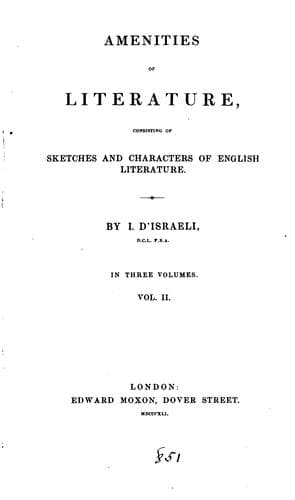
Amenities of Literature: Consisting of Sketches and Characters of English LiteratureDisraeli, Isaac
History
Amenities of Literature: Consisting of Sketches and Characters of English Literature
Disraeli, Isaac
Authors, English -- Biography; English literature -- History and criticism; Great Britain -- Intellectual life
Henry the Seventh, when Earl of Richmond, during his exile in France
from 1471 to 1485, had become a reader of French romances, an admirer of
French players, and an amateur of their peculiar architecture. After his
accession we trace these new tastes in our poetry, our drama, and in a
novel species of architecture which Bishop Fox called Burgundian, and
which is the origin of the Tudor style.[1] A favourer of the histrionic
art, he introduced a troop of French players. Wary in his pleasures as
in his politics, this monarch was moderate in his patronage either of
poets or players, but he was careful to encourage both. The queen
participated in his tastes, and appears to have bestowed particular
rewards on "players", whose performances had afforded her unusual
delight; and among the curious items of her majesty's expenditure, we
find that many of these players were foreigners--"a French player, an
Italian poet, a Spanish tumbler, a Flemish tumbler, a Welshman for
making a ryme, a maid that came out of Spain and danced before the
queen."
This monarch had suffered one of those royal marriages which are a
tribute paid to the interests of the State. Henry had yielded with
repugnance to a union with Elizabeth the Yorkist; the sullen Lancastrian
long looked on his queen with the eyes of a factionist. Toward the
latter years of his life this repugnance seems to have passed away, as
this gentle consort largely participated in his tastes. It was probably
in their sympathy that the personal prejudices of Henry melted away.
This indeed was a triumph of the arts of imagination over the warped
feelings of the individual; it marked the transition from barbaric arms
to the amenities of literature, and the softening influence of the
mimetic arts; it was the presage of the magnificence of his successor.
The nation was benefited by these new tastes; the pacific reign made a
revolution in our court, our manners, and our literature.
Public-domain text, read in full here on John Shaqi.
Reviews
Reviews
No reviews yet
Be the first to share your thoughts on this work.
Elsewhere in the archive
Join the Discussion
Join the discussion
Sign in to leave a comment or review.
Sign InorCreate an account