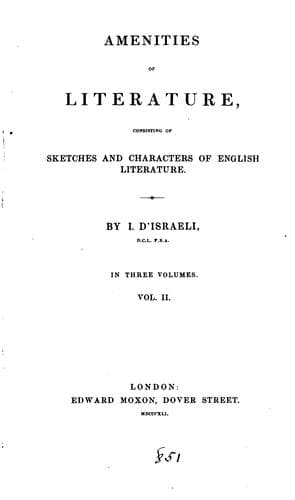
Amenities of Literature: Consisting of Sketches and Characters of English LiteratureDisraeli, Isaac
History
Amenities of Literature: Consisting of Sketches and Characters of English Literature
Disraeli, Isaac
Authors, English -- Biography; English literature -- History and criticism; Great Britain -- Intellectual life
We may date from this period that happy intercourse which the learned
English opened with the Continent, and more particularly with literary
Italy; our learned travellers now appear in number. Colet, the founder
of St. Paul's School, not only passed over to Paris, but lingered in
Italy, and returned home with the enthusiasm of classical antiquity.
Grocyn, to acquire the true pronunciation of the Greek, which he first
taught at Oxford, domesticated with Demetrius Chalcondyles and Angelo
Politian, at Florence. Linacre, the projector of the College of
Physicians, visited Rome and Florence. Lilly, the grammarian, we find at
Rhodes and at Rome, and the learned Pace at Padua. We were thus early
great literary travellers; and the happier Continentalists, who rarely
move from their native homes, have often wondered at the restless
condition of those whom they have sometimes reproached as being
_Insulaires_; yet they may be reminded that we have done no more than
the most ancient philosophers of antiquity. Our reproachers fortunately
possessed the arts, and even the learning, which we were willing by
travel and costs to acquire. "The Islanders" may have combined all the
knowledge of all the world, a freedom and enlargement of the mind, which
those, however more fortunately placed, can rarely possess, who restrict
their locality and narrow their comprehension by their own home-bound
limits.
The king, delighting in poetry, fostered an English muse in the learned
rhyme of STEPHEN HAWES, who was admitted to his private chamber, for the
pleasure which Henry experienced in listening to poetic recitation. It
was probably the taste of his royal master which inspired this bard's
allegorical romance of chivalry, of love, and of science. This elaborate
work is "The Pastime of Pleasure, or the History of Graunde Amour and la
bell Pucell, containing the knowledge of the seven sciences and the
course of man's life." At a time when sciences had no reality, they were
constantly alluding to them; ignorance hardily imposed its erudition;
and experimental philosophy only terminated in necromancy. The seven
sciences of the accomplished gentleman were those so well known,
comprised in the scholastic distich.
In the ideal hero "Graunde Amour," is shadowed forth the education of a
complete gentleman of that day. From the Tower of "Doctrine," to the
Castle of "Chivalry," the way lies equally open, but the progress is
diversified by many bye-paths, and a number of personified ideas or
allegorical characters. These shadowy actors lead to shadowy places; but
the abounding incidents relieve us among this troop of passionless
creatures.
Public-domain text, read in full here on John Shaqi.
Reviews
Reviews
No reviews yet
Be the first to share your thoughts on this work.
Elsewhere in the archive
Join the Discussion
Join the discussion
Sign in to leave a comment or review.
Sign InorCreate an account