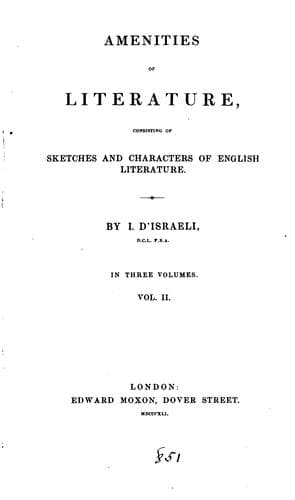
Amenities of Literature: Consisting of Sketches and Characters of English LiteratureDisraeli, Isaac
History
Amenities of Literature: Consisting of Sketches and Characters of English Literature
Disraeli, Isaac
Authors, English -- Biography; English literature -- History and criticism; Great Britain -- Intellectual life
This fiction blends allegory with romance, and science with chivalry. At
the early period of printing, it was probably the first volume which
called in the graver's art to heighten the inventions of the writer, and
the accompanying wood-cuts are an evidence of the elegant taste of the
author, although that morose critic of all poesy, honest Anthony à Wood,
sarcastically concludes that these cuts were "to enable the reader to
understand the story better." This once courtly volume, our sage
reports, "is now thought but worthy of a ballad-monger's stall."[2]
"The Pastime of Pleasure" was even despised by that great
book-collector, General Lord Fairfax, who, on the copy he possessed, has
left a memorandum "that it should be changed for a better book!" The
fate of books vacillates with the fancies of book-lovers, and the
improvements of a later age. In the days of Fairfax, the gloom of the
civil wars annihilated their imaginations.
But the gorgeousness of this romance struck the Gothic fancy of the
historian of our poetry, magic, chivalry, and allegory! In the
circumstantial analysis of Warton, the reader may pursue his "course of
man's life" through the windings of the labyrinth. It seems as if the
patience of the critic had sought a relief amid his prolonged chronicle
of obscure versifiers, in a production of imagination, the only one
which had appeared since Chaucer, and which, to the contemplative poetic
antiquary, showed him the infant rudiments of the future Spenser.
This allegorical romance is imbued with Provençal fancy, and probably
emulated the "Roman de la Rose," which could not fail to be a favourite
with the royal patron, among those French books which he loved. Fertile
in invention, it is, however, of the old stock; fresh meads and
delicious gardens,--ladies in arbours,--magical trials of armed knights
on horses of steel, which, touched by a secret spring, could represent a
tourney. We strike the shield at the castle-gate of chivalry, and we
view the golden roof of the hall, lighted up by a carbuncle of
prodigious size; we repose in chambers walled with silver, and
enamelling many a story. There are many noble conceptions among the
allegorical gentry. She, whom Graunde Amour first beheld was mounted on
her palfrey, flying with the wind, encircled with tongues of fire, and
her two milkwhite greyhounds, on whose golden collars are inscribed in
diamond letters, _Grace_ and _Governance_. She is Fame, her palfrey is
Pegasus, and her burning tongues are the voice of Posterity! There are
some grotesque incidents, as in other romances; a monster wildly
created, the offspring of Disdain and Strangeness--a demon composed of
the seven metals! We have also a dwarf who has to encounter a giant with
seven heads; our subdolous David mounts on twelve steps cut in the rock;
and to the surprise of the giant, he discovered in "the boy whom he had
mocked," his equal in stature, and his vanquisher, notwithstanding the
Public-domain text, read in full here on John Shaqi.
Reviews
Reviews
No reviews yet
Be the first to share your thoughts on this work.
Elsewhere in the archive
Join the Discussion
Join the discussion
Sign in to leave a comment or review.
Sign InorCreate an account