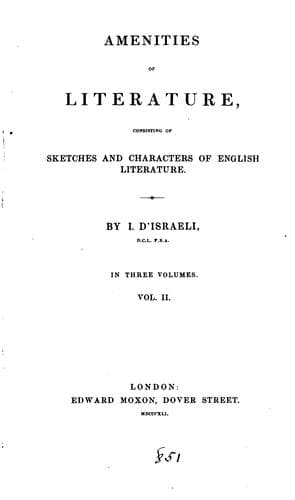
Amenities of Literature: Consisting of Sketches and Characters of English LiteratureDisraeli, Isaac
History
Amenities of Literature: Consisting of Sketches and Characters of English Literature
Disraeli, Isaac
Authors, English -- Biography; English literature -- History and criticism; Great Britain -- Intellectual life
[2] This forlorn volume of Anthony's "Stalls" is now a gem placed in
the caskets of black-letter. This poetic romance, by its excessive
rarity,--the British Museum is without a copy,--has obtained most
extraordinary prices among our collectors. A copy of the first
edition at the Roxburgh sale reached 84_l._, which was sold at Sir M.
M. Sykes' for half the price; later editions, for a fourth. A copy
was sold at Heber's sale for 25_l._ It may, however, relieve the
distress of some curious readers to be informed that it may now be
obtained at the most ordinary cost of books. Mr. SOUTHEY, with
excellent judgment, has preserved the romance in his valuable volume
of "Specimens of our Ancient Poets," from the time of Chaucer; it is
to be regretted, however, that the text is not correctly printed, and
that the poem has suffered mutilation--six thousand lines seem to
have exhausted the patience of the modern typographer. [A more
perfect and accurate edition, from that printed in 1555, was
published by the Percy Society in 1845, under the editorship of Mr.
Thos. Wright.]
FIRST SOURCES OF MODERN HISTORY.
Society must have considerably advanced ere it could have produced an
historical record; and who could have furnished even the semblance but
the most instructed class, in the enjoyment of uninterrupted leisure,
among every people? History therefore remained long a consecrated thing
in the hands of the priesthood, from the polytheistical era of the Roman
Pontiffs who registered their annals, to the days that the history of
Christian Europe became chronicled by the monastic orders.[1] Had it not
been for the monks, exclaimed our learned Marsham, we should not have
had a history of England.
The monks provided those chronicles which have served both for the
ecclesiastical and civil histories of every European people. In every
abbey the most able of its inmates, or the abbot himself, was appointed
to record every considerable transaction in the kingdom, and sometimes
extended their views to foreign parts. All these were set down in a
volume reserved for this purpose; and on the decease of every sovereign
these memorials were laid before the general chapter, to draw out a sort
of chronological history, occasionally with a random comment, as the
humour of the scribe prompted, or the opinions of the whole monastery
sanctioned.
Public-domain text, read in full here on John Shaqi.
Reviews
Reviews
No reviews yet
Be the first to share your thoughts on this work.
Elsewhere in the archive
Join the Discussion
Join the discussion
Sign in to leave a comment or review.
Sign InorCreate an account