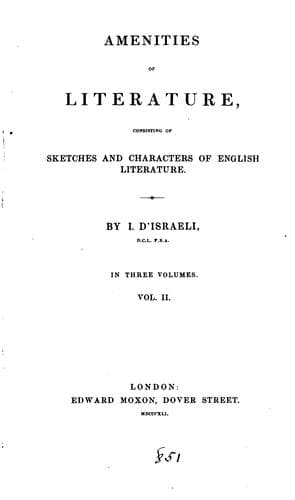
Amenities of Literature: Consisting of Sketches and Characters of English LiteratureDisraeli, Isaac
History
Amenities of Literature: Consisting of Sketches and Characters of English Literature
Disraeli, Isaac
Authors, English -- Biography; English literature -- History and criticism; Great Britain -- Intellectual life
Besides these meagre annals the monasteries had other books more curious
than their record of public affairs. These were their Leiger-books, of
which some have escaped among the few reliques of the universal
dissolution of the monasteries. In these registers or diaries they
entered all matters relating to their own monastery and its
dependencies. As time never pressed on the monkish secretary, his
notabilia runs on very miscellaneously. Here were descents of families,
and tenures of estates; authorities of charters and of cartularies;
curious customs of counties, cities, and great towns. Strange accidents
were not uncommon then; and sometimes, between a miracle or a natural
phenomenon, a fugitive anecdote stole in. The affairs of a monastery
exhibited a moving picture of domestic life. These religious houses,
whose gate opened to the wayfarer, and who were the distributors of
useful commodities to the neighbouring poor--for in their larger
establishments they included workmen of every class--did not, however,
maintain their munificence untainted by mundane passions. Forged
charters had often sealed their possessions, and supposititious grants
of mortuary donations silently transferred the wealth of families. These
lords of the soil, though easy landlords, still cast an "evil eye" on
the lands of their neighbour. Even rival monasteries have fought in
meadows for the ownership; the stratagems of war and the battle-array of
two troops of cudgelling monks might have furnished some cantos to an
epic, less comic perhaps than that of "The Rape of the Bucket."
In the literary simplicity of the twelfth to the fourteenth century,
while every great monastery had its historian, every chronicle derived
its title from its locality; thus, among others, were the Glastonbury,
the Peterborough, and the Abingdon Chronicles: and when Leland, so late
as the reign of Henry the Eighth, in his search into monastic libraries,
discovered one at St. Neot's, he was at a loss to describe it otherwise
than as "The Chronicle of St. Neot's." The famous Doomsday Book was
originally known as "Liber de Winton," or "The Winchester Book," from
its first place of custody. The same circumstance occurred among our
neighbours, where _Les grandes Chroniques de Saint Denys_ were so called
from having been collected or compiled by the monks of that abbey. An
abstract notion of history, or any critical discrimination of one
chronicle from another, was not as yet familiar even to our scholars;
and in the dearth of literature the classical models of antiquity were
yet imperfectly contemplated.
Public-domain text, read in full here on John Shaqi.
Reviews
Reviews
No reviews yet
Be the first to share your thoughts on this work.
Elsewhere in the archive
Join the Discussion
Join the discussion
Sign in to leave a comment or review.
Sign InorCreate an account