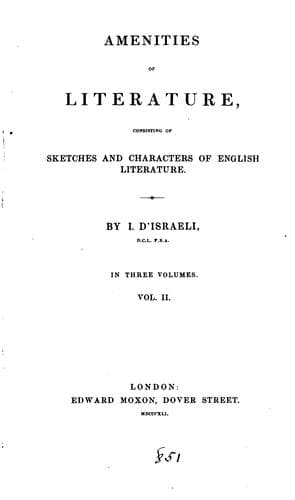
Amenities of Literature: Consisting of Sketches and Characters of English LiteratureDisraeli, Isaac
History
Amenities of Literature: Consisting of Sketches and Characters of English Literature
Disraeli, Isaac
Authors, English -- Biography; English literature -- History and criticism; Great Britain -- Intellectual life
The court of Henry displayed a brilliant circle of literary noblemen,
distinguished for their translations, and some by their songs and
sonnets. Parker, Lord Morley, was a favourite for his numerous versions,
some of which he dedicated to the king; the witty Wyat, who always
sustained the anagram of his name, was a familiar companion; nor could
Henry be insensible to the elegant effusions of Surrey, unless his
political feelings indisposed his admiration. It was at the king's
command that Lord Berners translated the "Chronicles of Froissart," and
the volume is adorned by the royal arms. Sternhold, the memorable
psalm-enditer, was a groom of the chamber, and a personal favourite with
his master; and Henry appointed the illustrious Leland to search for and
to preserve the antiquities of England, and invested him with the
honourable title of "The King's Antiquary."
Scholars, too, stood around the royal table; and the company at the
palace excelled that of any academy, as Erasmus has told us. Learning
patronised by a despot became a fashionable accomplishment, and the
model for the court was in the royal family themselves. It is from this
period that we may date that race of learned ladies which continued
through the long reign of our maiden queen. Yet, before the accession
of Henry the Eighth, half a century had not elapsed when female
literature was at so low an ebb that Sir Thomas More noticed as an
extraordinary circumstance that Jane Shore could read and write. When
Erasmus visited the English court, he curiously observed that "The
course of human affairs was changed; the monks, famed in time passed for
learning, are become ignorant, and WOMEN LOVE BOOKS." Erasmus had
witnessed at the court of Henry the Eighth the Princess Mary and
Elizabeth, both of whom held an epistolary correspondence in Latin; the
daughter of Sir Anthony Cook, and Lady Jane Grey, versed in Greek; and
the Queen Catherine Parr, his fervent admirer for his paraphrase on the
four gospels. Erasmus had frequented the house of the More's, which he
describes as a perfect _musarum domicilium_. The venerable Nicholas
Udall, a contemporary, has also left us a picture of that day. "It is
now a common thing to see young virgins so nouzeld (nursed) and trained
in the study of letters, that they willingly set all other vain pastimes
at nought--reading and writing, and with most earnest study, both early
and late." The pliable nobility of Henry the Eighth easily took the bend
of the royal family, and among their daughters, doubtless, there were
more learned women than are chronicled in Ballard's "Memoirs." Lady Jane
Grey meditating on Plato was not so uncommon an incident as it appears
to us in the insulated anecdote. The learning of that day must not be
held as the pedantry of a later, for it was laying the foundations of
every knowledge in the soil of England.
Public-domain text, read in full here on John Shaqi.
Reviews
Reviews
No reviews yet
Be the first to share your thoughts on this work.
Elsewhere in the archive
Join the Discussion
Join the discussion
Sign in to leave a comment or review.
Sign InorCreate an account