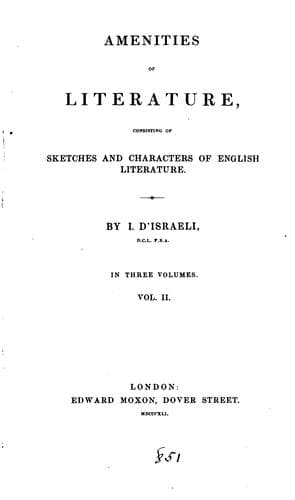
Amenities of Literature: Consisting of Sketches and Characters of English LiteratureDisraeli, Isaac
History
Amenities of Literature: Consisting of Sketches and Characters of English Literature
Disraeli, Isaac
Authors, English -- Biography; English literature -- History and criticism; Great Britain -- Intellectual life
The king's more elegant tastes diffused themselves among the finer arts
at a time when they were yet strangers in this land; his father's
travelled taste had received a tincture of these arts when abroad, in
Henry the Eighth they burst into existence with a more robust aptitude.
He eagerly invited foreign artists to his court; but the patronage of an
English monarch was not yet appreciated by some of the finest geniuses
of Italy; we lay yet too far out of their observation and sympathies;
and it is recorded of one of the Italian artists, a fiery spirit, who
had visited England, that he designated us as _quelle bestie Inglesi_.
Raphael and Titian could not be lured from their studios and their blue
skies; but, fortunately, a northern genius, whose name is as immortal as
their own, was domiciliated by the liberal monarch, the friend of
Erasmus and of More--Hans Holbein.
Among the musicians of Henry we find French, Italians, and Germans; he
was himself a musician, and composed several pieces which I believe are
still retained in the service of the Royal Chapel.[3] He had a taste for
the gorgeous or grotesque amusements of the Continent, combining them
with a display of the fine arts in their scenical effects. One memorable
night of the Epiphany, the court was startled by a new glory, where the
king and his companions appeared in a scene which the courtiers had
never before witnessed. "It was a mask after the manner of Italy, a
thing not seen afore in England," saith the chronicler of Henry's
court-days. Once, to amaze a foreign embassy, and on a sudden to raise
up a banqueting-house, the monarch set to work the right magicians; an
architect, and a poet, and his master of the revels, were months
inventing and labouring. The regal banqueting-house was adorned by the
arts of picture and music, of sculpture and architecture; all was full
of illusion and reality; the house itself was a pageant to exhibit a
pageant. The magnificent prince was himself so pleased, that he
anxiously stopped his visitors at the points of sight most favourable to
catch the illusion of the perspective. A monarch of such fine tastes and
gorgeous fancies would create the artists who are the true inventors.
FOOTNOTES:
[1] The manuscript of Henry the Eighth reposes in the Vatican,
witnessed by his own hand in this inscription:--"Anglorum Rex,
Henricus Leoni X. 'mittit hoc opus et fidei testem et amicitiæ.'"--I
found this inscription in one of the notes of Selden to the
"Polyolbion" of Drayton.
[2] The famous Grammar of Lilly was the work of a learned
association, in which it appears that both the king and the cardinal
had the honour to co-operate. Sir Thomas Elyot has designated Henry
"as the chief author."--Preface to "The Castle of Health."
[3] Sir John Hawkins' "History of Music," vol. ii.
BOOKS OF THE PEOPLE.
Public-domain text, read in full here on John Shaqi.
Reviews
Reviews
No reviews yet
Be the first to share your thoughts on this work.
Elsewhere in the archive
Join the Discussion
Join the discussion
Sign in to leave a comment or review.
Sign InorCreate an account