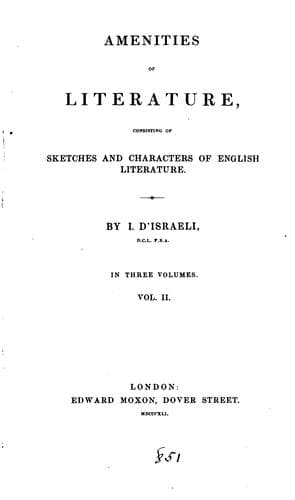
Amenities of Literature: Consisting of Sketches and Characters of English LiteratureDisraeli, Isaac
History
Amenities of Literature: Consisting of Sketches and Characters of English Literature
Disraeli, Isaac
Authors, English -- Biography; English literature -- History and criticism; Great Britain -- Intellectual life
This political fiction has been traced in several languages to an
earlier period than the thirteenth century. The learned Germans hold it
to be a complete picture of the feudal manners; and Heineccius, one of
the most able jurists, declares that it has often assisted him in
clearing up the jurisprudence of Germany, and that for the genius of the
writer the volume deserves to be ranked with the classics of antiquity.
The writer probably had good reasons for concealing his name, but his
intimacy with a Court-life is apparent. He has dexterously described the
wiles of Reynard, whose cunning overreached his opponents; his wit, his
learning, his humour, and knowledge of mankind, are of no ordinary
degree; and this favourite satire contributed, no less than the works of
Erasmus, of Rabelais, and of Boccaccio, to pave the way for the
Reformation. It was among the earliest productions of the press in
Germany and in England, and became so popular here that on the old
altar-piece of Canterbury cathedral are several paintings taken from
this pungent satire. The modern Italian poet, CASTI, seems to have
borrowed the plan of his famous political satire "Gl' Animali Parlanti"
from Reynard the Fox.
The Germans have occasionally borrowed from us, as we also from the
Italian jest-books, many of our "tales and quick answers;" the facetiæ
of Poggius and Domenichi, and others, have been a fertile source of our
own.
All tales have wings, whether they come from the east or the north, and
they soon become denizens wherever they alight. Thus it has happened
that the tale which charmed the wandering Arab in his tent, or cheered
the Northern peasant by his winter-fire, alike held on its journey
toward England and Scotland. Dr. Leyden was surprised when he first
perused the fabliaux of "The Poor Scholar," "The Three Thieves," and
"The Sexton of Cluni," to recognise the popular stories which he had
often heard in infancy. He was then young in the poetical studies of the
antiquary, or he would not have been at a loss to know whether the Scots
drew their tales from the French, or the French from their Scottish
intercourse; or whether they originated with the Celtic, or the
Scandinavian, or sometimes even with the Orientalists.
Public-domain text, read in full here on John Shaqi.
Reviews
Reviews
No reviews yet
Be the first to share your thoughts on this work.
Elsewhere in the archive
Join the Discussion
Join the discussion
Sign in to leave a comment or review.
Sign InorCreate an account