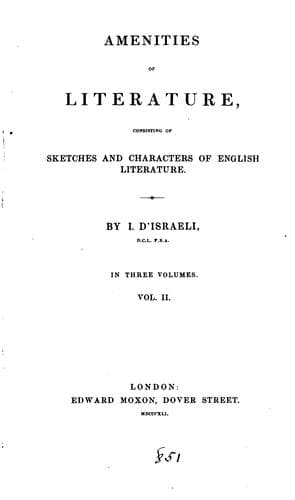
Amenities of Literature: Consisting of Sketches and Characters of English LiteratureDisraeli, Isaac
History
Amenities of Literature: Consisting of Sketches and Characters of English Literature
Disraeli, Isaac
Authors, English -- Biography; English literature -- History and criticism; Great Britain -- Intellectual life
The courtly favourites of a former age descended from the oriel window
to the cottage-lattice; perpetuated in our "chap-books," sold on the
stalls of fairs, and mixed with the wares of "the chapman," they became
the books of the people. "The Gestes" of Guy of Warwick and Sir Bevis
of Hampton, and other fabulous heroes of chivalry, have been recognised
in their humble disguise of the "Tom Thumb," and "Tom Hickathrift," and
"Jack the Giant-Killer" of the people.
In France their "bibliothèque bleue," books now in the shape of
pamphlets, deriving their name from the colour of their wrappers,
preserves the remains of the fugitive literature of the people; and in
Italy to this day several of the old romances of chivalry are cut down
to a single paul's purchase, and delight the humble buyers.[7] Guerin
Meschino, of native origin, still retains his popularity. In Germany
some patriotic antiquaries have delighted to collect this household
literature of the illiterate. The Germans, who, more than any other
nation, seem to have cherished the hallowed feelings of the homestead,
have a term to designate this class of literature; they call these
volumes _Volksbücher_, or "the people's books."
There existed a more intimate intercourse between the vernacular writers
of Germany and our own than appears yet to have been investigated. "The
Merry Jests of Howleglas," most delectable to the people from their
grossness and their humour, is of German origin; and it has been
recently discovered that "The History of Friar Rush," which perplexed
the researches of Ritson, is a literal prose version of a German poem,
printed in 1587.[8] "Reynard the Fox"--a most amusing Æsopian
history--an exquisite satire on the vices of the clergy, the devices of
courtiers, and not sparing majesty itself--an intelligible manual of
profound Machiavelism, displaying the trickery of circumventing and
supplanting, and parrying off opponents by sleights of wit--was
translated by Caxton from the Dutch.[9]
Public-domain text, read in full here on John Shaqi.
Reviews
Reviews
No reviews yet
Be the first to share your thoughts on this work.
Elsewhere in the archive
Join the Discussion
Join the discussion
Sign in to leave a comment or review.
Sign InorCreate an account