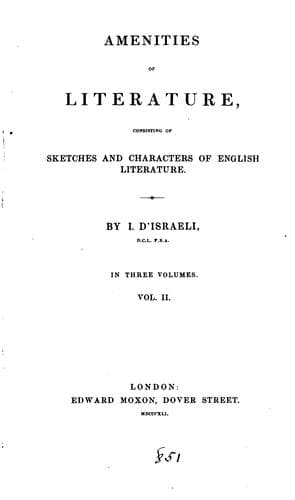
Amenities of Literature: Consisting of Sketches and Characters of English LiteratureDisraeli, Isaac
History
Amenities of Literature: Consisting of Sketches and Characters of English Literature
Disraeli, Isaac
Authors, English -- Biography; English literature -- History and criticism; Great Britain -- Intellectual life
ELYOT for us had been little more than a name, as have been many retired
students, from the negligence of contemporaries, had he not been one of
those interesting authors who have let us into the history of their own
minds, and either prospectively have delighted to contemplate on their
future enterprises, or retrospectively have exulted in their past
labours.
This amiable scholar had been introduced at Court early in life; his
"great friend and crony was Sir Thomas More;" so plain Anthony à Wood
indicates the familiar intercourse of two great men. Elyot was a
favourite with Henry the Eighth, and employed on various embassies,
particularly on the confidential one to Rome to negotiate the divorce of
Queen Katherine. To his public employments he alludes in his first work,
"The Governor," which "he had gathered as well of the sayings of most
noble authors, Greek and Latin, as by his own experience, he being
continually trained in some daily affairs of the public weal from his
childhood."
A passion for literature seems to have prevailed over the ambition of
active life, and on his return from his last embassy he decided to write
books "in our vulgar tongue," on a great variety of topics, to instruct
his countrymen. The diversity of his reading, and an unwearied pen,
happily qualified, in this early age of the literature of a nation, a
student who was impatient to diffuse that knowledge which he felt he
only effectually possessed in the degree, and in the space, which he
communicated it.
His first elaborate work is entitled, "The Boke of the Governor, devised
by Sir Thomas Elyot," 1531,--a work once so popular, that it passed
through seven or eight editions, and is still valued by the collectors
of our ancient literature.
"The Governor" is one of those treatises which, at an early period of
civilization, when general education is imperfect, becomes useful to
mould the manners and to inculcate the morals which should distinguish
the courtier and the statesman. Elyot takes his future "Governor" in the
arms of his nurse, and places the ideal being amid all the scenes which
may exercise the virtues, or the studies which he developes. The work is
dedicated to Henry the Eighth. The design, the imaginary personage, the
author and the patron, are equally dignified. The style is grave; and it
would not be candid in a modern critic to observe that, in the progress
of time, the good sense has become too obvious, and the perpetual
illustrations from ancient history too familiar. The erudition in
philology of that day has become a schoolboy's learning. They had then
no other volumes to recur to of any authority, but what the ancients had
left.
Public-domain text, read in full here on John Shaqi.
Reviews
Reviews
No reviews yet
Be the first to share your thoughts on this work.
Elsewhere in the archive
Join the Discussion
Join the discussion
Sign in to leave a comment or review.
Sign InorCreate an account