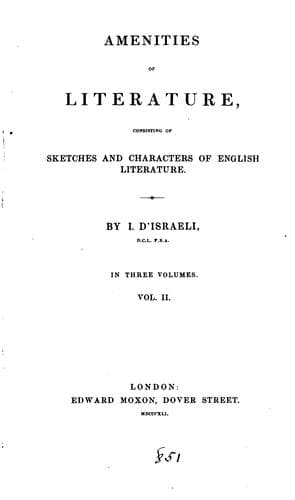
Amenities of Literature: Consisting of Sketches and Characters of English LiteratureDisraeli, Isaac
History
Amenities of Literature: Consisting of Sketches and Characters of English Literature
Disraeli, Isaac
Authors, English -- Biography; English literature -- History and criticism; Great Britain -- Intellectual life
Elyot had a notion that, for the last thousand years, the world had
deteriorated, and that the human mind had not expanded through the
course of ages. When he compared the writers of this long series of
centuries, the babbling, though the subtle, schoolmen, who had chained
us down to their artificial forms, with the great authors of antiquity,
there seemed an appearance of truth in his decision. Christianity had
not yet exhibited to modern Europe the refined moralities of Seneca, and
the curious knowledge of Plutarch, in the homilies of Saints and
Fathers; nor had its histories of man, confined to our monkish
annalists, emulated the narrative charms of Livy, nor the grandeur of
Tacitus. Of the poets of antiquity, Elyot declared that the English
language, at the time he wrote, could convey nothing equivalent, wanting
even words to express the delicacies, "the turns," and the euphony of
the Latin verse.
A curious evidence of the jejune state of the public mind at this period
appears in this volume. Here a learned and grave writer solemnly sets
forth several chapters on "that honest pastime of dancing," in which he
discovers a series of modern allegories. The various figures and
reciprocal movements between man and woman, "holding each other by the
hand," indicate the order, concord, prudence, and other virtues so
necessary for the common weal. The _singles_ and _reprinses_ exhibit the
virtue of circumspection, which excites the writer to a panegyric of the
father of the reigning sovereign. These ethics of the dance contain some
curious notices, and masters in the art might hence have embellished
their treatises on the philosophy of dance; for "in its wonderful
figures, which the Greeks do call _idea_, are comprehended so many
virtues and noble qualities." It is amusing to observe how men willingly
become the dupes of their fancies, by affecting to discover motives and
analogies, the most unconnected imaginable with the objects themselves.
Long after our polished statesman wrote, the Puritan excommunicated the
sinful dancer, and detected in the graceful evolutions of "the honour,"
the "brawl," and the "single," with all their moral movements, the
artifices of Satan, and the perdition of the souls of two partners,
dancing too well. It was the mode of that age thus to moralise, or
allegorise, on the common acts of life, and to sanction their idlest
amusements by some religious motive. At this period, in France, we find
a famous _Veneur_, Gaston Phebus, opening his treatise on "hunting" in
the spirit that Elyot had opened to us the mysteries of dancing. "By
hunting, we escape from the seven mortal sins, and therefore, the more
we hunt, the salvation of our souls will be the more secure. Every good
hunter in this world will have joyance, glee, and solace, (_joyeuseté,
liesse, et deduit_,) and secure himself a place in Paradise, not perhaps
in the midst, but in the suburbs, because he has shunned idleness, the
root of all evil."
Public-domain text, read in full here on John Shaqi.
Reviews
Reviews
No reviews yet
Be the first to share your thoughts on this work.
Elsewhere in the archive
Join the Discussion
Join the discussion
Sign in to leave a comment or review.
Sign InorCreate an account