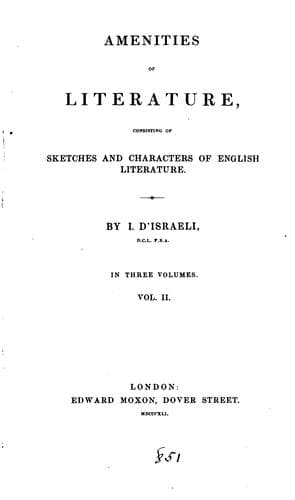
Amenities of Literature: Consisting of Sketches and Characters of English LiteratureDisraeli, Isaac
History
Amenities of Literature: Consisting of Sketches and Characters of English Literature
Disraeli, Isaac
Authors, English -- Biography; English literature -- History and criticism; Great Britain -- Intellectual life
In this early attempt to cultivate "the vulgar tongue," some cavilled
at his strange terms. It is a striking instance of the simplicity of the
critics at that early period of our language, that our author formally
explains the word _maturity_--"a Latin word, which I am constrained to
usurp, lacking a name in English, and which, though it be strange and
dark, yet may be understood as other words late comen out of Italy and
France, and made denizens among us." Augustus Cæsar, it seems, had
frequently in his mouth this word _matura_--do maturely! as "if he
should have said, Do neither too much nor too little--too swiftly nor
too slowly." Elyot would confine the figurative Latin term to a
metaphysical designation of the acts of men in their most perfect state,
"reserving," as he says, "the word ripeness to fruit and other things,
separate from affairs, as we have now in usage." Elyot exults in having
augmented the English language by the introduction of this Latin term,
now made English for the first time! It has flourished as well as this
other, "the _redolent_ savours of sweet herbs and flowers." But his ear
was not always musical, and some of his neologisms are less
graceful--"_an alective_," to wit; "_fatigate_," to fatigue; "_ostent_,"
to show, and to "_sufficate_ some disputation." Such were the first weak
steps of the fathers of our language, who, however, culled for us many a
flower among their cockle.
But a murmur more prejudicial arose than the idle cavil of new and hard
words; for some asserted that "the Boke seemed to be overlong." Our
primeval author considered that "knowledge of wisdom cannot be shortly
declared." Elyot had not yet attained, by sufficient practice in
authorship, the secret, that the volume which he had so much pleasure in
writing could be over tedious in reading. "For those," he observes
sarcastically, "who be well willing, it is soon learned--in good faith
sooner than primero or gleek." The nation must have then consisted of
young readers, when a diminutive volume in twelves was deemed to be
"overlong." In this apology for his writings, he threw out an undaunted
declaration of his resolution to proceed with future volumes.--"If the
readers of my works, by the noble example of our most dear sovereign
lord, do justly and lovingly interpret my labours, I, during the residue
of my life, will now and then set forth such fruits of my study,
profitable, as I trust, unto this my country, leaving malicious readers
with their incurable fury." Such was the innocent criticism of our
earliest writer--his pen was hardly tipped with gall.
Public-domain text, read in full here on John Shaqi.
Reviews
Reviews
No reviews yet
Be the first to share your thoughts on this work.
Elsewhere in the archive
Join the Discussion
Join the discussion
Sign in to leave a comment or review.
Sign InorCreate an account