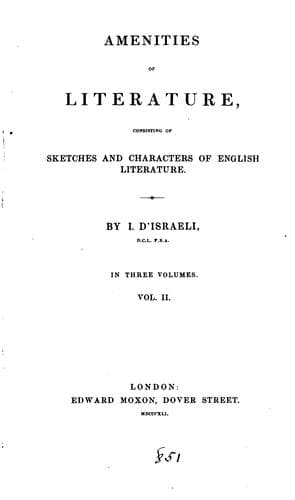
Amenities of Literature: Consisting of Sketches and Characters of English LiteratureDisraeli, Isaac
History
Amenities of Literature: Consisting of Sketches and Characters of English Literature
Disraeli, Isaac
Authors, English -- Biography; English literature -- History and criticism; Great Britain -- Intellectual life
As all subjects were equally seductive to the artless pen of a primitive
author, who had yet no rivals to encounter in public, Elyot turned his
useful studies to a topic very opposite to that of political ethics. He
put forth "The Castle of Health," a medical treatise, which passed
through nearly as many honourable editions as "The Governor." It did
not, however, abate the number, though it changed the character of his
cavillers, who were now the whole corporate body of the physicians!
The author has told his amusing story in the preface to a third edition,
in 1541.
"Why should I be grieved with reproaches wherewith some of my country do
recompense me for my labours, taken without hope of temporal reward,
only for the fervent affection which I have ever borne toward the public
weal of my country? 'A worthy matter!' saith one; 'Sir Thomas Elyot has
become a physician, and writeth on physic, which beseemeth not a knight;
he might have been much better occupied.' Truly, if they will call him a
physician who is studious of the weal of his country, let men so name
me."
But there was no shame in studying this science, or setting forth any
book, being--
"Thereto provoked by the noble example of my noble master King Henry
VIII.; for his Highness hath not disdained to be the chief author of an
introduction to grammar for the children of his subjects.
"If physicians be angry that I have written physic in English, let them
remember that Greeks wrote in Greek, the Romans in Latin, and Avicenna
in Arabic, which were their own proper and maternal tongues. These were
paynims and Jews, but in this part of charity they far surmounted us
Christians."
Several years after, when our author reverted to his "Castle of Health,"
the Castle was brightened by the beams of public favour. Its author now
exulted that "It shall long preserve men, be some physicians never so
angry." The work had not been intended to depreciate medical
professors, but "for their commodity, by instructing the sick, and
observing a good order in diet, preventing the great causes of sickness,
or by which they could the sooner be cured." Our philosopher had
attempted to draw aside that mystifying veil with which some affected to
envelope the arcana of medicine, as if they were desirous "of writing in
cypher that none but themselves could read." Our author had anticipated
that revolution in medical science which afterwards, at a distant
period, has been productive of some of the ablest treatises in the
vernacular languages of Europe.
The patriotic studies of Elyot did not terminate in these ethical and
popular volumes, for he had taxed his daily diligence for his country's
weal. This appeared in "The Dictionary of Sir Thomas Elyot, 1535," a
folio, which laid the foundation of our future lexicons, "declaring
Latin by English," as Elyot describes his own labour.
Public-domain text, read in full here on John Shaqi.
Reviews
Reviews
No reviews yet
Be the first to share your thoughts on this work.
Elsewhere in the archive
Join the Discussion
Join the discussion
Sign in to leave a comment or review.
Sign InorCreate an account